Making Indoor Play More Interesting for Your Cat
 Johnathan Parker |
October 13, 2026 |
2:29 pm
Johnathan Parker |
October 13, 2026 |
2:29 pm
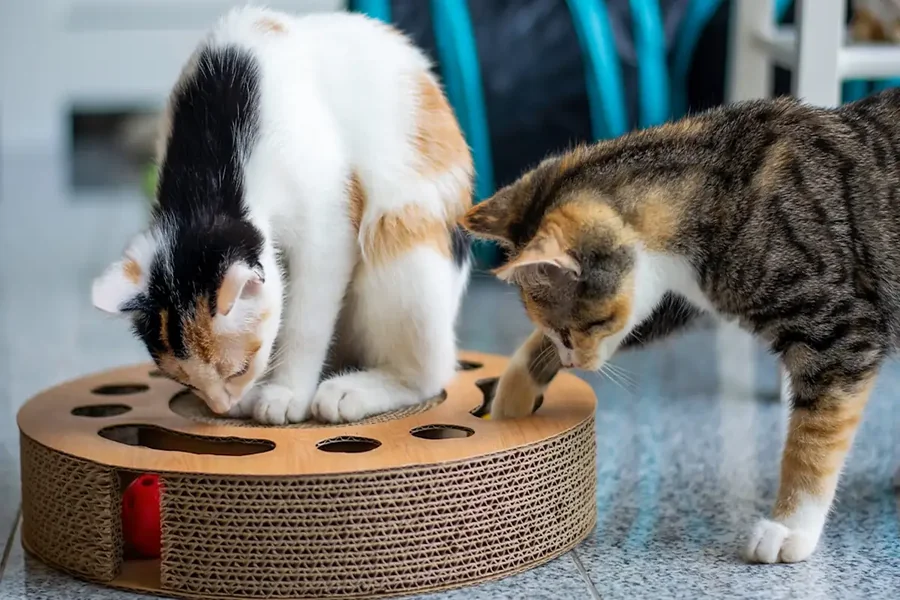
A cat can have a comfortable home and still need more opportunities to explore, investigate, and play. For an indoor cat, those opportunities depend largely on what happens inside the household. A useful play routine gives the cat something to watch, approach, chase, and catch, while allowing them to choose when to join in.
The starting point is observation rather than a large shopping basket. Notice what your cat already does: waits behind a chair, bats an object along the floor, carries a soft toy, or follows movement near a doorway. These small preferences can help you design games that fit the individual animal and the space you share.
Watch before choosing a toy
Spend a few ordinary days noticing where play begins. Does your cat become curious when something disappears behind furniture? Do they prefer a slow movement across the floor to a toy waved overhead? Are they interested in a game before breakfast but indifferent in the afternoon? Write down a few examples rather than relying on a general impression that the cat is “lazy” or “fussy.”
Use those observations to choose one activity to test. For a cat that watches from cover, try moving a supervised wand lure past the edge of a box. For a cat that bats objects, offer a suitable rolling toy on a clear floor. You are testing an invitation, not trying to make the cat perform on demand.
When comparing interactive cat toys for indoor cats, Cat Universe’s toy collection offers a relevant starting point, with its page describing wand-style play, automatic toys, and feeding puzzles. Compare each product’s instructions and construction with the game you want to create. A category name alone cannot tell you whether a particular toy suits your cat or can be left out safely.
Make the movement worth following
Think of a play session as a series of small decisions for the cat. The toy appears, moves away, pauses, and becomes available again. Try a short movement followed by stillness, then see whether the cat approaches. Constantly waving a toy close to their face can make the game difficult to read and gives them little control.
Keep the lure away from your hands and feet. Cats Protection’s guidance on play recommends using appropriate toys rather than encouraging attacks on fingers or toes, and allowing the cat to catch the toy periodically. A physical catch also gives you a natural moment to pause before starting another short sequence.
Change one feature at a time when interest fades. You might slow the movement, move the game to a quieter room, or let the lure disappear partly behind a safe object. If you change the toy, location, and movement all at once, it becomes harder to understand which adjustment helped. Watching is part of participation, so allow a pause without immediately escalating the game.
Build a small selection with clear purposes
A useful toy collection can be modest. Choose items that offer different experiences instead of several versions of the same activity. This makes it easier to learn which games your cat returns to and which purchases are simply adding clutter.
Consider a few roles for the collection:
1.A supervised wand toy for games you control together.
2. A suitable ball or sturdy batting toy for a clear floor area.
3. A soft, appropriately sized toy that can be grabbed and held.
4. An easy feeding puzzle, used with part of the cat’s usual food allowance.
5. A spare favourite to use while another toy is being cleaned or replaced.
This list is a planning aid rather than a requirement to buy five products. If your cat enjoys only two of these activities, build around those. Likewise, an electronic toy is optional. Before choosing one, check noise, movement, battery access, cleaning instructions, and whether the manufacturer requires supervision. Test it while you are present instead of assuming automatic operation means unattended use is suitable.
Make the room part of the game
Set up a clear area with footing your cat can use comfortably. Remove breakable objects and avoid directing a fast chase towards stairs, trailing cables, or unstable furniture. A small space can work well when the game uses short movements and pauses rather than a long sprint.
Use the same room in different ways. A toy moving past a doorway offers a different view from one travelling across the middle of the floor. A secure cardboard box with hazardous packaging removed can create a place to watch from. Keep an exit available so the cat can leave without being cornered.
The RSPCA’s indoor-cat advice includes both daily play and opportunities to climb, hide, and scratch. That wider environment matters when planning games: toys are one part of the home, and play should fit around comfortable resting places and everyday resources rather than crowd them out.
Fit play into a routine you can keep
Choose a few convenient points in the day when you can give the cat your attention. A brief game before you begin work or after an evening task may be easier to maintain than an ambitious schedule. Let your cat’s response determine the session length, and stop when they disengage rather than continuing until the toy is ignored.
Try keeping a simple record for a week. Note the time, toy, location, and whether the cat watched, approached, chased, or caught it. These observations are more useful than rating every session as a success or failure. A quiet stalking game and an energetic chase can both tell you something about preference.
In a household with several cats, offer individual turns when one cat consistently takes over. Do not assume watching another cat play provides the same experience as having access to the toy. Separate spaces may help you see each cat’s choices without competition.
Check condition and adjust expectations
Inspect toys before use. Look for loose pieces, damaged seams, exposed stuffing, and worn attachments. Put away strings, wand toys, and anything that could entangle the cat when the session ends. Follow product instructions, and retire damaged toys instead of relying on supervision to make them safe.
Adapt the game to the cat in front of you. Keep movements low and gentle if jumping is uncomfortable, and avoid interpreting a sudden loss of interest as a shopping problem. A new change in activity or behaviour deserves a veterinary conversation, particularly when it comes with other changes.
Let your cat’s response guide the next session
An interesting indoor play routine grows from attention to small details. Begin with one suitable toy, an uncluttered space, and a movement your cat wants to follow. Keep the game manageable, allow catches and pauses, and use what you observe to shape the next attempt. The aim is a repeatable opportunity to play together, not a collection that looks impressive in a cupboard.