Inside Celebrity Garages: How Pop Culture Icons and Influencers Store Their Million-Dollar Car Collections
 Johnathan Parker |
July 18, 2026 |
11:31 am
Johnathan Parker |
July 18, 2026 |
11:31 am
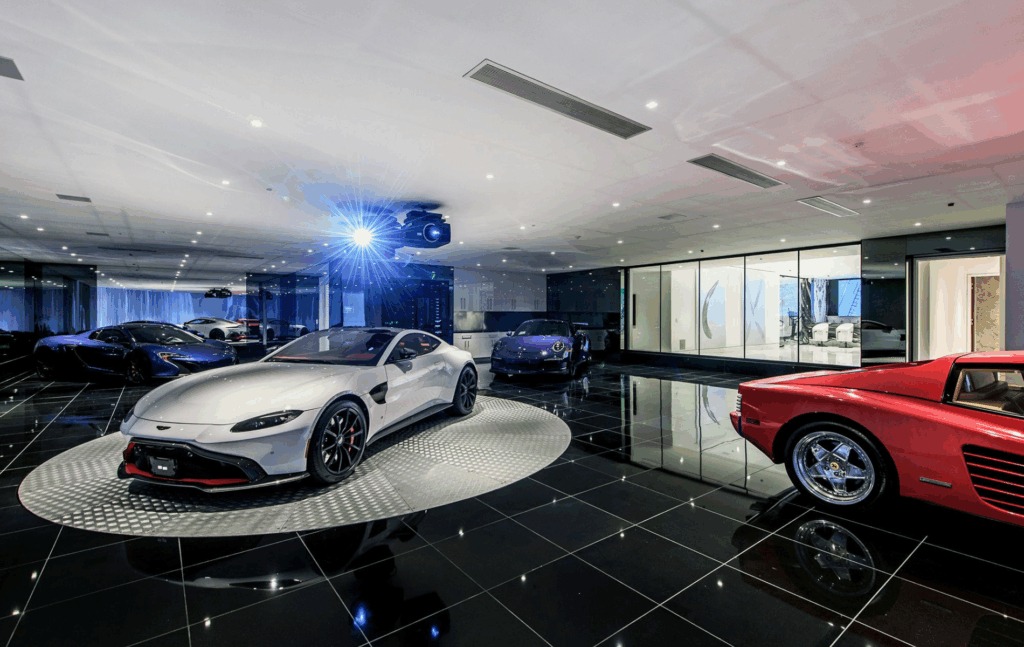
Celebrities do not park million-dollar car collections. They archive them. A serious celebrity garage is a purpose-built, climate-controlled private building with monitored security, hydraulic lifts, gallery lighting and a mechanic on payroll, and it almost always sits on its own footprint instead of being attached to the house. Jay Leno runs a 122,000 square foot complex in Burbank. Jerry Seinfeld gutted a Manhattan factory. YouTube collectors design theirs to be filmed. The buildings look nothing alike, but the logic underneath every one of them is the same: dry air, controlled access, and cars kept ready to drive at any hour.
Why the garage stopped being a garage
Because the cars stopped being transport and became assets, and assets get displayed. Architects who work for the very wealthy now call these rooms gallery spaces, and they design them the way you would design a room for paintings. Poured resin has replaced bare concrete. Lighting sits recessed in the floor so the cars appear to float. A turntable rotates a Bugatti into position without anyone touching the wheel.
The same instinct has worked its way down the market. Scroll through garages for sale in New York and the vocabulary has quietly changed: insulated walls, finished lofts, workshop bays, second stories, real windows. People are not shopping for somewhere to leave the car overnight anymore. They are shopping for a room they intend to spend time in. The celebrity version is that exact idea with a few extra zeros bolted on.
How does Jerry Seinfeld store his Porsche collection in Manhattan?
He bought the building. Facing the worst parking market in America, Seinfeld took a plain three-story structure on the west side of Manhattan, a former plumbing factory, and rebuilt it as a private climate-controlled garage with a car elevator, an office and a kitchen. From the sidewalk it reads as nothing at all. Inside sit dozens of Porsches valued in the tens of millions, plus a maintenance crew whose entire job is making sure any one of them fires on the first turn of the key.
That last detail is the one people skip past. Seinfeld does not collect cars to look at them, and neither does Leno. A collection that never moves slowly destroys itself. Seals dry out, fuel turns to varnish, tires develop flat spots, rotors bloom with rust. The genuinely expensive part of luxury car storage is not the finish work. It is the labor needed to keep forty or eighty vehicles in a state where any of them could be driven this afternoon.
Jay Leno’s Big Dog garage and the working museum model
Leno’s garage is a factory, not a showroom. Big Dog Garage in Burbank holds somewhere north of 180 cars and a motorcycle collection nearly as large across 122,000 square feet, and the centerpiece is not a hypercar. It is the machine shop.
His team fabricates parts that nobody has manufactured in a hundred years, which is the only realistic way to keep a 1906 steam car breathing. Every vehicle in the building is insured, registered and drivable. The show that made the place famous came second. The garage existed long before the cameras did, and that is precisely why it works as a template: nothing in it is decoration. Every system in that building is there because something in the collection needed it.
The influencer garage is built for the camera as much as for the cars
Influencer garages are content studios that happen to hold cars. That is the biggest shift in this world over the past decade. When your income depends on a garage tour clearing a few million views, the room needs sight lines, reflective floors, consistent color temperature and enough width for a gimbal operator to walk backwards without clipping a mirror.
Manny Khoshbin is the cleanest example. The Orange County real estate developer turned hypercar collector owns a one-off Hermes-trimmed Bugatti Chiron, a Pagani Huayra with leather stitched in Paris, a satin carbon McLaren P1 and a row of Mercedes-Benz SLR McLarens, and his purpose-built headquarters looks less like a garage than a set from a Bond film. TheStradman turned building his Utah garage into a running storyline. Shmee150 films everybody else’s. Supercar Blondie made the reveal itself into a format.
The economics are worth stating plainly, because they explain the architecture. For these collectors, the building is a production asset. It generates the views that pay for the cars that fill the building.
Five famous collections at a glance
The best-known celebrity car collections all solve one problem, in five different ways: how do you keep something priceless, fragile and mechanical both safe and usable?
| Collector | Where the cars live | The detail everyone remembers |
|---|---|---|
| Jay Leno | 122,000 sq ft complex, Burbank | A working machine shop that makes parts the world stopped producing |
| Jerry Seinfeld | Three-story former factory, Manhattan | A car elevator instead of a driveway |
| Ralph Lauren | Private gallery, white walls, stainless plinths | A 1938 Bugatti Type 57SC Atlantic lit like a painting |
| Manny Khoshbin | Purpose-built headquarters, Orange County | Bespoke Hermes hypercars, filmed for millions of viewers |
| Gil Dezer | Porsche Design Tower, Miami | An elevator that delivers his cars into his apartment |
What is actually inside a million-dollar garage
Mostly boring engineering. Strip away the resin floors and the systems list is short, unglamorous and nearly identical from one collection to the next:
- climate control holding roughly 60 to 70 degrees and 50 to 55 percent relative humidity, because moisture, not mileage, is what kills a stored car;
- a battery tender on every vehicle, so nothing sits with a dead cell for six months;
- four-post lifts or hydraulic stackers, which double capacity without doubling the footprint;
- sealed epoxy or resin floors that shrug off oil, tire marks and dust;
- fire suppression and monitored alarms, since insurers ask about both before writing an agreed-value policy;
- ventilation sized for running engines rather than for lawn tools;
- rodent control, which sounds trivial until a mouse eats a wiring loom.
Notice what is missing from that list. None of it is exotic. It is the checklist a careful owner uses for one car, scaled up and paid for properly.
Questions people actually ask
How much does a celebrity garage cost to build?
Anywhere from a few hundred thousand dollars to well past ten million. At the top of the market, a trackside garage at a private motorsport club can run seven figures on its own before a single car parks inside it. The variable is not the walls. It is the climate systems, the lifts, the security and the staff.
Do celebrities drive the cars, or are they just investments?
Both, and the answer splits the community. Leno and Seinfeld drive theirs and say so loudly. Plenty of other collections are held purely as investment positions, parked in third-party warehouses whose owners sometimes never visit. Classic cars have been one of the stronger performing collectible categories for years, which is why a warehouse full of untouched Ferraris makes perfect sense to somebody.
What is the single biggest mistake in a home car garage?
Skipping the envelope. People spend on cabinets, lighting and a flashy floor, then run a dehumidifier inside a building that leaks air through every seam. Insulation and sealing come first. Everything else is decoration sitting on top of that.
What regular collectors can copy without a Hollywood budget
Almost all of it, minus the square footage. The principles cost very little. Scale is the part that costs money, and scale is optional.
- Go detached if the lot allows it, because a separate structure buys you ceiling height, distance from the house and freedom on placement;
- Insulate and seal before spending a dollar on finishes;
- Plan for twelve feet of clear height if a lift is ever going to be part of the picture;
- Leave three to four feet of working room around each car, or a door will get scraped inside a year;
- Wire it properly the first time, with 240 volts, more outlets than you think you need, and light bright enough to spot a paint defect.
The other thing worth borrowing is the delivery model. Nobody famous project-manages their own build, and there is no real reason a homeowner should either. A turnkey garage construction company like “Storage Sheds And Garages” handles the design, the permits, the delivery and the on-site assembly of Amish-built prefab structures, so a detached two-car building goes up in days instead of tying up a general contractor for a season. Permitting is where most home garage projects die quietly, so having that carried by someone else matters more than the brochure suggests.
The fascination with celebrity garages was never really about Bugattis. It is about the idea that a car deserves a room of its own. Leno worked that out decades ago in a Burbank hangar. Seinfeld worked it out in a Manhattan factory. The version most people can actually build sits at the end of a driveway, holds two cars instead of two hundred, and runs on exactly the same principles.