How Businesses Can Use AI Without Putting Sensitive Data at Risk
 Johnathan Parker |
August 25, 2026 |
5:46 pm
Johnathan Parker |
August 25, 2026 |
5:46 pm
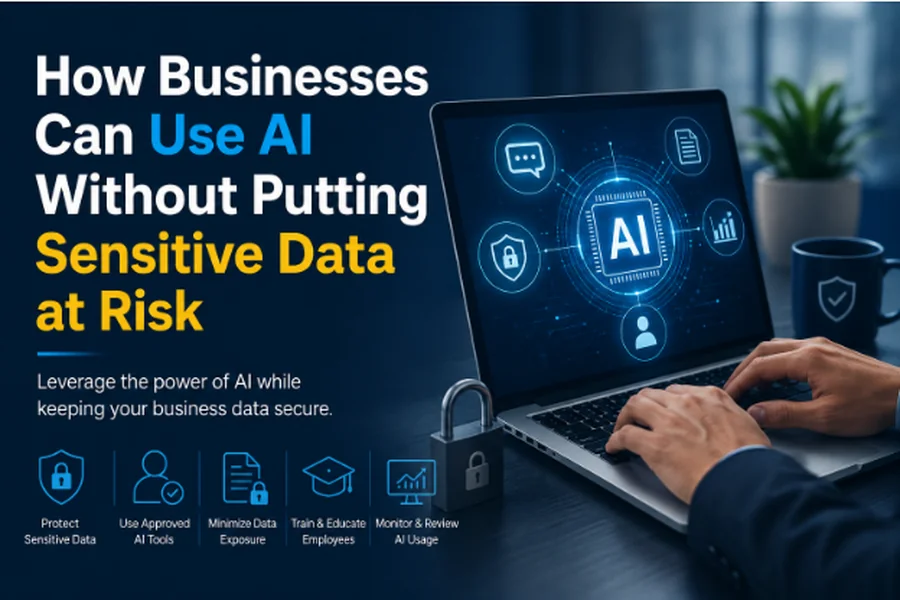
Artificial intelligence is becoming a practical part of everyday business. Companies use AI to draft emails, summarize documents, analyze information, create marketing content, assist with research, review code, and automate repetitive tasks. These tools can save significant time, but they also introduce an important question: what happens to the information employees provide to an AI system?
Businesses often work with customer information, internal documents, financial records, contracts, employee details, source code, and confidential strategies. Sending this information to the wrong AI tool can create unnecessary privacy and security risks. The goal, therefore, should not be to avoid AI completely. Instead, businesses need a responsible approach that allows employees to benefit from AI while keeping sensitive information protected.
Understand What Data Is Sensitive
The first step is identifying information that should receive additional protection. Sensitive business data can include customer names and contact details, passwords, financial information, private contracts, employee records, unpublished business plans, proprietary source code, API keys, internal reports, and confidential communications.
Not every piece of business information carries the same level of risk. A public product description is very different from a spreadsheet containing customer information. Companies should classify their information so employees can quickly understand what they can and cannot provide to an AI tool.
Clear rules are especially important because employees may not intentionally expose confidential information. They might simply paste an entire email, document, or spreadsheet into an AI system because they want a quick summary. Data classification helps prevent these everyday mistakes.
Create Clear Rules for AI Use
Businesses should establish a simple AI usage policy before allowing widespread adoption. The policy does not need to be complicated. Employees mainly need to know which AI tools are approved, what information they are allowed to enter, what information must never be entered, and who they should contact when they are unsure.
The rules should use language employees can understand instead of relying entirely on technical or legal terminology. For example, a company might state that passwords, customer financial information, confidential contracts, private employee information, and access credentials must never be pasted into an unapproved AI platform.
Resources such as https://evostai.com/ can also help businesses understand practical AI use in the workplace, including how teams can think about company data, AI policies, output verification, and responsible adoption.
Use Approved AI Tools
Allowing employees to use any AI service they find online can make data management difficult. Instead, businesses should create a list of approved platforms that have been reviewed for security, privacy, and suitability.
Before approving a service, decision-makers should examine how the provider processes submitted information. Important questions include whether prompts are stored, how long information is retained, whether customer data may be used for model training, where information is processed, what administrative controls are available, and whether data can be deleted.
Businesses should also review vendor terms carefully rather than assuming that every paid or enterprise AI product provides the same level of protection. Different services can have significantly different data-handling policies.
Remove Sensitive Information Before Using AI
One of the easiest ways to reduce risk is to avoid providing unnecessary confidential information in the first place. Employees can often receive useful AI assistance without including real names, account numbers, email addresses, customer IDs, financial figures, or other identifying details.
For example, an employee who wants AI to improve a customer service response usually does not need to provide the customer’s full identity. Personal details can be replaced with generic labels such as “Customer A” or “Client Company.”
The same principle applies to documents. Instead of uploading an entire confidential contract to ask about one paragraph, employees can extract the relevant section and remove identifying information. Giving an AI system only the minimum information required for a task reduces exposure while still allowing the business to benefit from the technology.
Protect Passwords, API Keys, and Login Credentials
Credentials require particularly strict protection. Passwords, authentication tokens, private keys, database credentials, recovery codes, and API keys should never be entered into general-purpose AI tools.
This becomes especially important when developers use AI to troubleshoot code. A developer may copy a configuration file or error message without realizing that it contains a database password or API token.
Companies should train technical teams to review code and logs before submitting them to external AI systems. Secrets should be removed or replaced with placeholders. Automated secret-detection tools can provide another layer of protection.
Control Access to AI Systems
Security is not only about what employees enter into AI platforms. Businesses should also control who can access those platforms and associated company information.
Employees should receive only the permissions necessary for their roles. Strong authentication should be required, and multi-factor authentication should be enabled whenever possible. When an employee leaves the organization or changes roles, access should be removed or adjusted promptly.
For larger organizations, centralized administration can make AI usage easier to manage. Administrators may be able to control accounts, monitor usage, manage permissions, and enforce security requirements from one place.
Train Employees With Real Examples
A written policy alone is unlikely to prevent every mistake. Employees need practical training that demonstrates both appropriate and inappropriate uses of AI.
Instead of providing only general warnings about confidential data, businesses can show realistic examples. Employees can learn how to summarize a document after removing identifying information, how to rewrite an email without including customer details, and how to ask an AI system for assistance without uploading an entire internal report.
Training should also explain that AI-generated answers can be incorrect. Protecting data is only one part of responsible AI adoption. Employees should verify important outputs before using them for financial, legal, technical, customer-facing, or strategic decisions.
Monitor AI Usage and Update Policies
AI technology develops quickly, and business policies should evolve with it. A tool that is suitable today may change its terms, features, integrations, or data practices later.
Companies should periodically review their approved AI services and evaluate whether employees are following internal guidelines. They should also create an easy process for reporting accidental disclosure or questionable AI activity.
When employees know where to report a mistake, the company can respond faster. Depending on the situation, that might involve changing credentials, contacting a vendor, restricting access, investigating exposure, or following an internal incident-response procedure.
Balance Productivity With Data Protection
Businesses do not have to choose between AI productivity and information security. The two can work together when organizations introduce sensible controls.
The safest approach is to minimize the amount of sensitive information shared with AI systems, approve tools before employees use them for company work, carefully review vendor data practices, protect credentials, restrict access, and provide practical employee training.
AI can help businesses work faster, but convenience should never replace good security practices. Organizations that establish clear boundaries from the beginning are better positioned to use AI confidently while protecting customers, employees, intellectual property, and other valuable business information.
Final Thoughts
AI adoption should be treated like the introduction of any other important business technology. Companies need to understand where information goes, who has access to it, and what risks exist before incorporating a platform into daily workflows.
A simple principle can guide most decisions: provide an AI tool only with the information it genuinely needs to perform the task. Combined with approved tools, clear policies, employee education, access controls, and regular reviews, this approach allows businesses to gain meaningful value from AI without unnecessarily putting sensitive data at risk.