Hi3D V3.0: Redefining AI 3D Creation from Digital Ideas to Production-Ready Models
 Johnathan Parker |
August 21, 2026 |
8:07 pm
Johnathan Parker |
August 21, 2026 |
8:07 pm
AI and 3D printing are gradually changing the way people create, design, and produce physical objects. From personal collectibles and creative projects to professional prototypes and digital assets, more users are looking for simpler ways to transform ideas into printable 3D models. However, creating high-quality 3D content still requires complex modeling skills, technical knowledge, and a long preparation process.
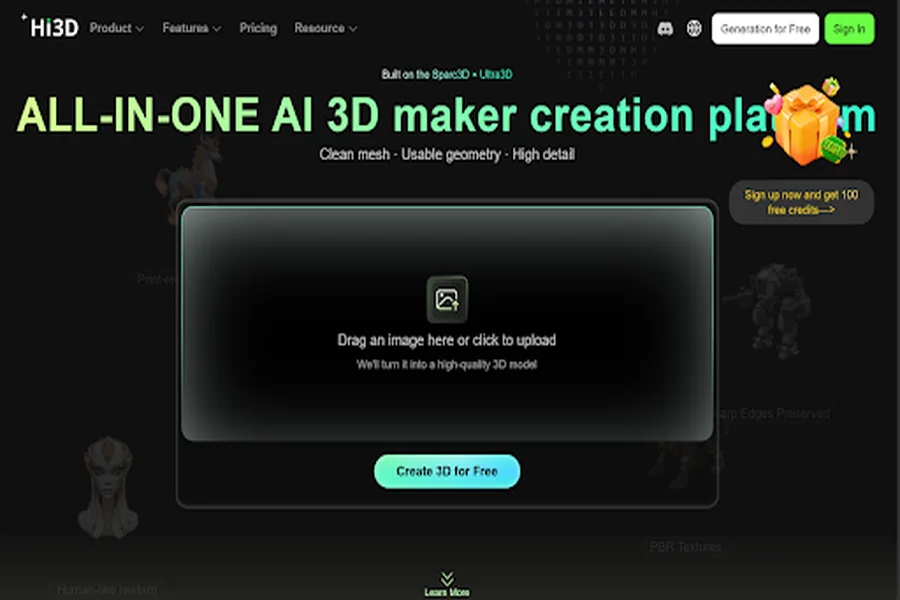
Hi3D is built to reduce these barriers by connecting AI generation with real 3D production needs. As an AI-powered 3D creation platform, Hi3D helps users move from images, text ideas, and digital concepts to usable 3D assets more efficiently. With the release of Hi3D V3.0, the platform takes another major step forward, focusing not only on generating models, but also on improving their quality, usability, and ability to enter real production workflows.
For creators, designers, and 3D printing enthusiasts, the future of AI 3D creation is no longer only about making a model appear on screen. The more important question is whether that model can become a high-quality, editable, and printable object. Hi3D V3.0 is designed around this challenge.
-
Why AI 3D Creation Needs to Move from Generation to Real Production
The growth of AI has made content creation faster than ever, but 3D creation still faces unique challenges. Unlike images or text, a 3D model needs accurate geometry, stable structure, clear textures, and compatibility with downstream production processes.
Many users experience the same problems during the creative process. Beginners may have creative ideas but lack professional modeling skills. Designers may spend significant time adjusting details after AI generation. 3D printing users may receive models that look impressive digitally but require additional repair before printing.
Hi3D focuses on solving these problems by improving the entire journey from concept creation to physical output.
1.1 Turning creative ideas into usable 3D assets
For individual creators, one of the biggest difficulties is converting a simple idea into a complete 3D object. Traditional modeling software often requires professional skills and extensive learning time. AI-powered generation provides a new possibility by allowing users to start with more natural inputs.
With Hi3D, users can create 3D models through image-based and text-based generation. Instead of building every detail manually, creators can use existing visual references or descriptions to quickly explore different ideas.
This makes Hi3D not only a creative assistant but also an accessible AI 3D model maker for users who want to experiment with 3D creation without mastering complicated modeling workflows.
1.2 Improving the connection between digital models and physical printing
A successful 3D workflow does not end when a model is generated. The model needs to maintain structural accuracy, support detailed surfaces, and work effectively in real printing environments.
This is where Hi3D V3.0 focuses its major improvements. The update aims to reduce the gap between AI-generated models and production-ready assets, helping users spend less time fixing models and more time creating.
-
From Images and Words to 3D Models: Making Creation More Accessible
One of Hi3D’s key capabilities is helping users transform two-dimensional ideas into three-dimensional objects. Image-based and text-based generation allows creators to move beyond traditional modeling limitations and explore a faster way of creating digital assets.
2.1 Transforming visual references into complete 3D models
Many creators begin with an image: a character illustration, product concept, artwork, or personal design. Turning these references into 3D models traditionally requires rebuilding the object manually.
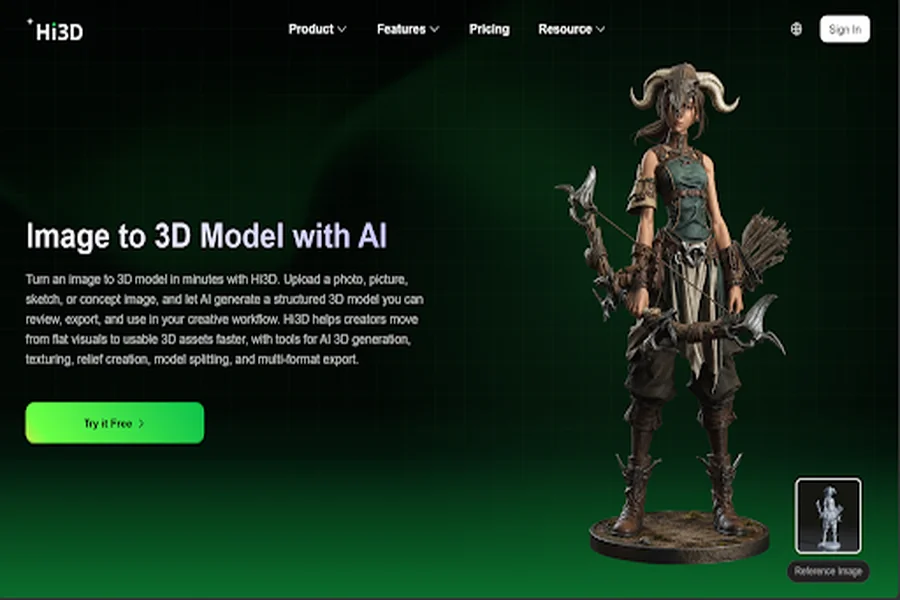
Hi3D simplifies this process through its image-to-3D generation capability. Users can upload visual references and generate corresponding 3D models with AI assistance. This approach allows artists, designers, and makers to quickly test ideas and create physical versions of concepts.
This technology, often described as image to 3D model, helps bridge the gap between two-dimensional creativity and three-dimensional manufacturing.
For example, a designer can start with a concept image, generate a 3D version, refine the details, and prepare it for further applications such as visualization, prototyping, or 3D printing.
2.2 Creating models through text-based imagination
Besides image references, text input provides another flexible way to create. Users can describe an object, character, or creative concept and allow AI to interpret the idea into a 3D model.
This is especially valuable for users who have strong creative ideas but limited modeling experience. Instead of learning complex software before starting, they can focus on describing what they want to create.
For educators, hobby creators, and independent designers, this lowers the entry barrier and makes 3D creation available to a wider audience.
2.3 Higher-quality generation with Hi3D V3.0
The release of Hi3D V3.0 represents a major improvement in AI 3D model quality. According to the official release information, Hi3D V3.0 increases geometric reconstruction resolution to 2048³ voxel-level, becoming the first commercially available AI 3D model with this level of resolution. The upgrade also improves texture output up to 8K and introduces enhanced cross-view structural reasoning and an upgraded UV completion algorithm.
This improvement is important because many previous AI-generated models struggled with small structures, complex surfaces, and hidden areas. Hi3D V3.0 focuses on preserving more details, including fine patterns, mechanical connections, thin structures, and surface changes.
For creators, better geometry means fewer corrections after generation and a smoother path from idea to finished model.
-
AI Texture Generation: Bringing More Detail and Personality to 3D Models
Geometry creates the shape of a model, but texture gives it personality and visual identity. For many creators, adding realistic or artistic textures is another time-consuming stage after modeling.
Hi3D addresses this challenge through AI-assisted texture generation, allowing users to create more detailed and visually complete 3D assets.
3.1 Reducing the difficulty of manual texturing
Traditional 3D texturing requires knowledge of UV mapping, material settings, and painting techniques. For beginners, this process can become one of the biggest obstacles after creating a model.
With AI texturing capabilities, Hi3D helps users generate surface details more efficiently. Instead of manually painting every area, creators can use AI assistance to enhance the appearance of their models.
This makes the platform useful for different creative scenarios, including character design, collectible creation, product visualization, and digital art.
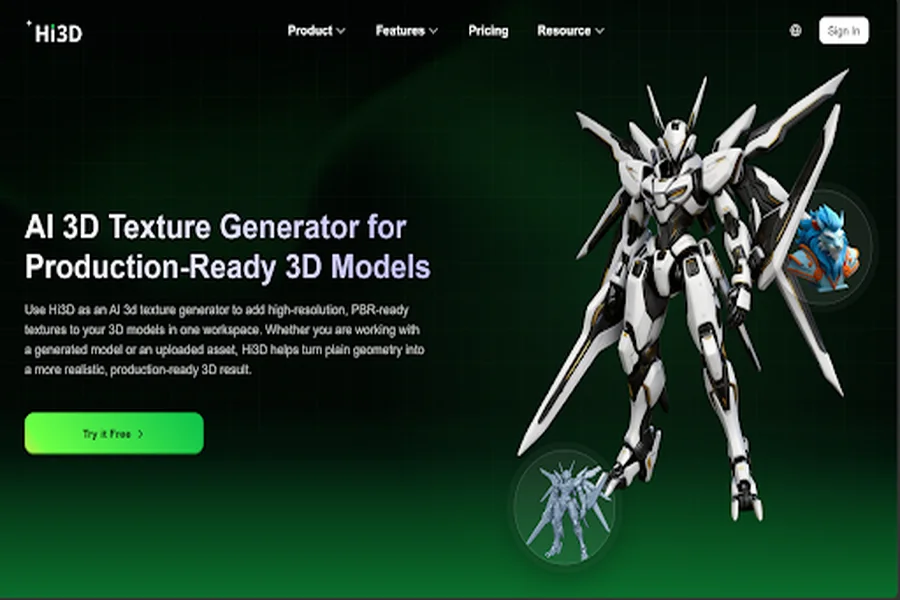
The capability can be described as an AI 3D model texture generator, helping transform basic models into more complete visual assets.
3.2 Higher-resolution textures with Hi3D V3.0
Texture quality is one of the major upgrades to Hi3D V3.0. The new version increases texture output capability to a maximum of 8K and improves the self-developed UV completion algorithm. These improvements help enhance pattern clarity, color transitions, and the recognition of detailed textures when viewed at larger scales.
This means creators can achieve richer surface details while maintaining better consistency across different areas of a model.
For industries that depend on visual quality, such as digital art, product design, collectibles, and creative manufacturing, improved texture generation provides more possibilities for professional-level results.
-
Additional Workflow Improvements: Multi-Color Printing, Splitting, and Smart Arrangement
While AI generation and texture creation are the main focuses of Hi3D, V3.0 also introduces important improvements that help models move closer to actual printing workflows.
These functions are designed to solve common problems after model generation, including preparing parts, managing colors, and optimizing printing arrangements.
4.1 Multi-color printing for more realistic physical results
Many AI-generated models look complete digitally but become difficult when users try to print them with multiple colors. Hi3D’s multi-color printing feature focuses on transforming textured models into printable multi-color objects by improving color region generation, filament color matching, and print preparation.
The system helps reduce unnecessary color fragmentation and provides more practical output for real printing workflows.
4.2 Split-for-printing and smart arrangement
For large models, characters, and collectible figures, printing a complete object at once is often difficult. Hi3D provides split-for-printing capabilities that separate models into printable parts, generate connectors, and help users prepare models for assembly.
The platform also supports smarter build plate arrangement and 3MF export with suggested printing settings, helping users reduce manual preparation before slicing.
Together, these improvements create a more complete workflow from AI generation to physical production.
-
Hi3D V3.0 Official Release: A New Stage for AI 3D Production
The launch of Hi3D V3.0 marks an important milestone in the development of AI 3D creation. Instead of focusing only on generating visually impressive models, this version places more attention on production requirements and real-world applications.
5.1 Three major upgrades from generation quality to delivery quality
Hi3D’s development has followed a clear path. V1.0 introduced a commercially available 1536³ voxel-resolution image-to-3D model. V2.0 focused on integrated geometry and texture generation, including structural completion and lighting removal. V3.0 continues this evolution by improving geometry accuracy, complex structure handling, texture quality, and production-related features such as smart splitting, multi-color printing, and arrangement tools.
The core goal of V3.0 is to reduce the manual adjustments needed before AI-generated assets can enter real workflows. The focus has shifted from simply creating models to creating assets that are more usable, editable, printable, and applicable.
5.2 Supporting wider industry applications
High-quality 3D assets are becoming increasingly important across many industries. From 3D printing and digital art to game development, jewelry design, collectibles, education, e-commerce content, and industrial design, different fields share the same demand for accurate geometry, stable structures, clear textures, and practical usability.
Hi3D V3.0 aims to lower the difficulty of producing high-quality 3D content and help more users access professional-level AI 3D creation.
Whether you are a designer exploring new concepts, a maker preparing models for printing, or a beginner entering the world of 3D creation, Hi3D provides a more efficient way to turn imagination into reality.
Hi3D V3.0 is now officially available, and users can experience the new generation of AI 3D creation through a limited 48-hour free trial. During the experience period, users can access Hi3D V3.0 without generation limits and explore its upgraded capabilities.
Start creating with Hi3D V3.0 and discover a faster way to transform ideas into production-ready 3D models.