What Used Server Memory Is Worth: RDIMMs, LRDIMMs, and the Rest of the Rack
 Johnathan Parker |
September 2, 2026 |
9:55 pm
Johnathan Parker |
September 2, 2026 |
9:55 pm
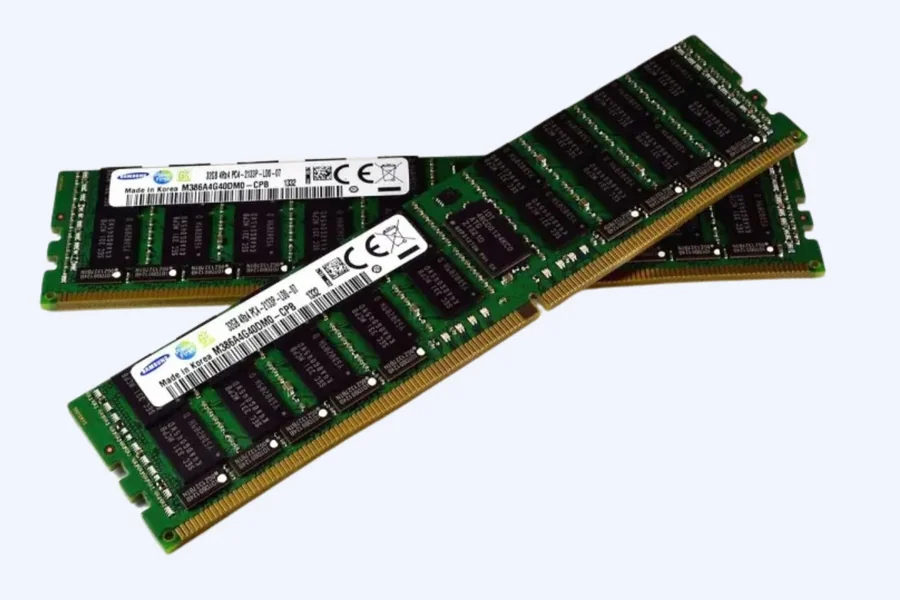
In July 2025, an 8GB DDR4 module outsold an 8GB DDR5 module on price. Industry trackers called the inversion rare. Samsung and SK hynix responded by delaying their DDR4 phase-out into 2026 instead of shutting the lines down as planned. Older memory, briefly, was worth more than newer memory.
Used hardware is not supposed to do that. Servers depreciate. Drives depreciate. Switches depreciate on a curve you can nearly draw from the model number and the year. Memory behaves differently. If you are holding pallets of DIMMs out of a refresh, that difference decides what you get paid.
Most of this guide covers server memory. It is the component people misjudge most. The rest of the rack turns up too, because nobody decommissions memory on its own.
Why memory does not behave like the rest of the rack
A used Dell R740 is worth what the market says a used R740 is worth. One model, one generation, a narrow band of buyers. Memory has none of that structure. A 32GB DDR4-2933 RDIMM is a commodity part. It drops into dozens of platforms. Its secondary value is pinned to what new modules cost that week.
So the used market moves when the new-part market moves, and it moves fast. The new-part market has been moving hard. TrendForce expected server DRAM contract prices to rise 13 to 18% quarter over quarter in the third quarter of 2026. Its July 9, 2026 release noted that buyers without long-term agreements would absorb most of that increase. HBM production for AI accelerators eats wafer capacity that would otherwise make conventional DRAM. Supply stays tight across the board.
Two things follow for sellers. Quotes go stale quickly, so a number from six weeks ago may be badly wrong in either direction. And memory tracks a live commodity price, which makes timing a genuine variable, not a rounding error. That cuts both ways. It comes up again further down.
The six things that decide what a DIMM is worth
Ask five buyers what a lot of memory is worth, and you get five numbers. Ask what they are looking at, and you get the same list.
Generation. DDR3, DDR4, DDR5. The single biggest lever, and readable from the pin count when the label is gone. DDR3 modules carry 240 pins. DDR4 carries 288. DDR5 also carries 288, notched in a different place, so the two do not interchange. DDR4 and DDR5 hold value far better than DDR3. DDR3 is not automatically scrap.
Capacity and density. A 64GB module is not simply twice a 32GB module in value. Higher-density parts serve buyers who are capacity-constrained per slot. They price accordingly.
Module type. Sellers get vague here and buyers get precise. A registered DIMM (RDIMM) puts a register between the memory controller and the DRAM chips. That buffers the address and command signals, which lets a server populate more modules per channel than an unbuffered DIMM allows. A load-reduced DIMM (LRDIMM) buffers the data lines as well. It trades a little latency for substantially higher capacity per channel. UDIMMs are unbuffered and generally desktop-class. SODIMMs are the small form factor used in laptops and some appliances. RDIMM and LRDIMM are the two that matter in a server. They do not substitute for each other.
Rank. Single-rank, dual-rank, quad-rank. Rank governs how many modules a platform accepts per channel, and at what speed. That decides which buyers can use your parts.
Speed grade. DDR4-2133 through DDR4-3200, DDR5-4800 and up. A slower module usually runs in a faster system, downclocked. It also caps the whole channel. So slow parts trade at a discount to fast parts of the same capacity.
Part number and condition. The manufacturer part number on the label settles every question above in one string. Buyers who ask for part numbers want to quote you accurately instead of defensively.
One term needs a plain definition, because it gets used loosely. ECC. Error-correcting code memory carries extra chips that detect and correct single-bit errors instead of letting data corrupt silently. Server memory is essentially always ECC. The errors are not theoretical. Google’s large-scale field study of its own fleet, published through the ACM, found that about a third of machines and over 8% of individual DIMMs saw at least one correctable error per year. Those rates ran well above what lab testing had predicted. Most errors traced to hard faults, not cosmic-ray soft errors. Which is why serious buyers test every module instead of sampling a tray.
Where mixed lots leak money
Memory is sold and used in populated sets. A server does not want forty random DIMMs. It wants matched modules in the configuration its population rules allow. Hand a buyer a pallet scraped out of eleven different chassis, and you have not given them a lot. You have given them a sorting job. The cost of that job comes out of your offer.
The usual mixed-lot problems, roughly in order of cost:
Mixed generations in the same box. DDR3 and DDR4 in one Gaylord means somebody separates them by hand before anything gets tested.
Mixed capacities and speeds inside a lot described as uniform. This is the one that most often turns a firm quote into a revised quote after arrival.
Broken sets. Sixteen modules of one part number beat sixteen modules across five part numbers. The first is a configuration. The second is a bin.
Missing labels. Heat, handling, and adhesive age all work against the sticker. A module without a readable part number has to be identified electrically.
Physical damage from pulls. Bent pins, cracked notches, modules stacked loose without antistatic protection. Memory is sturdy in normal use. A pallet of unprotected DIMMs in transit is a different situation.
An unpopular opinion, at least with anyone trying to clear a project in an afternoon: sort before you request a quote. An hour spent grouping by part number and counting into matched sets moves the offer more reliably than shopping the same messy pallet to four more buyers. If you cannot sort, say so plainly and let the buyer price the sorting in. Just do not describe a mixed lot as a clean one.
How memory compares with everything else you pulled
Memory rarely leaves a building alone. It leaves as part of a decommission, alongside the processors, the accelerators, the drives, and the networking gear. Those components behave differently enough that one pile is a mistake.
| Component | What mainly sets the value | How quickly value moves | Data risk before resale |
|---|---|---|---|
| Server memory (RDIMM, LRDIMM) | Generation, density, module type, rank, speed, matched sets | Fast, tracks live DRAM contract pricing | None once powered down |
| CPUs (Intel Xeon, AMD EPYC) | Generation, core count, SKU, socket compatibility | Moderate, generational and steady | None |
| Data-center GPUs and accelerators | Model, memory capacity, demand for AI capacity, cooling type | Fast and demand-driven | Nothing persistent, VRAM clears on power loss |
| Drives (SAS, SATA HDD, SSD, NVMe) | Capacity, interface, endurance and hours, form factor | Moderate | High, sanitization required first |
| Switches, firewalls, transceivers | Model, port count, licensing, optics included | Slow to moderate | Configuration data, keys and logs need clearing |
| LTO tape and tape drives | Generation, cartridge condition, drive hours | Slow | High, tape holds recoverable data |
The whole-versus-harvest question follows from that table rather than from a rule. Chassis, CPUs, and a full memory configuration all current-generation, unit complete: sell it whole. Complete working systems have buyers that loose parts do not. Chassis two generations behind while the DIMMs and accelerators are not: harvest. That is usually where the money sits.
What happens to a memory lot between pickup and payment
Most sellers have never seen this from the inside. It explains a lot about why quotes differ.
A serious memory intake runs roughly like this. The lot arrives and gets cataloged at the module level, not by weight or by pallet. Every module gets tested, not sampled. The ECC field data above is the reason: a module that posts is not necessarily clean under load. Parts are then binned by part number into sellable configurations. That is the sorting work a mixed lot pushes onto the buyer. Failures go to recycling, not back into the channel. Payment follows verification rather than receipt, which is why reputable buyers quote a payment window instead of a same-day promise.
Sellers raise a fair objection at this point: is used server RAM memory in bulk lots a real market, or a scrap channel with better manners? It is a real market, and it is a wholesale one. Big Data Supply buys exactly those lots. That means RDIMM and LRDIMM, DDR4 and DDR5. Single modules are not the business.
Then the data question, which comes up in every memory conversation. The answer is simpler than people expect. RAM holds no persistent user data once power is removed. DRAM is volatile by design. There is no wipe procedure for a DIMM, no sanitization certificate that means anything at the module level, and no reason to shred good memory in the name of security. Destruction paperwork shows up in memory deals for one reason: DIMMs rarely travel alone. The drives out of the same chassis do carry data. Those need proper sanitization under something like NIST Special Publication 800-88, revised to Rev. 2 on September 26, 2025, superseding the 2014 Rev. 1 that a lot of vendor documentation still quotes.
One related correction, since it circulates constantly. Degaussing is a magnetic operation. It erases a platter or a tape ribbon by destroying the field that encodes the bits. NAND stores charge, not magnetism, so a degausser hands an SSD back exactly as it found it. Flash needs the drive’s own sanitize command, or a crypto-erase that throws away the encryption key. Neither idea applies to a DIMM at all.
When drives ship alongside your memory, insist on serial-level documentation. A Certificate of Destruction listing individual serial numbers. Custody records covering collection through processing. Auditors ask for serials. A one-page letter saying “your equipment was destroyed” proves nothing.
Timing: holding a pallet of DIMMs is a position, not a plan
Because memory tracks a live commodity market, sellers get tempted to wait for a better number. Sometimes that works. In the recent market, it worked spectacularly for anyone holding DDR4 when the phase-out news hit.
The problem is that waiting is a trade. Most IT organizations are not set up to run trades. Held inventory carries real costs: floor space, insurance, handling, the risk of a warehouse move, and the ordinary risk that the person who knew what was on the pallet leaves. A common planning rule of thumb in decommissioning work puts the loss at something like a fifth to a third of recoverable value within six to twelve months of sitting. Treat that as guidance rather than measured data. The real figure depends entirely on which component you are holding.
For memory specifically. A reasoned view that the market is mid-move, plus the space to carry the inventory safely, makes waiting a quarter a fair bet. Waiting because the last quote felt low, with no view on supply, is just storing DIMMs. Put a date on the decision either way.
Where sellers leave the most money
Across decommissioning projects, the losses cluster in the same few places. Almost none of them involve negotiating harder.
They are about inventory. A lot described accurately and sorted properly gets a firm quote that survives arrival. A lot described loosely gets a conditional quote that is revised downward. They are about not letting good memory sit unlabeled in a corner for a year. And they are about matching the channel to the volume, because the buyer who wants forty matched RDIMMs is not the buyer who wants one.
The part number on the label does more work than anything else here. Read it, record it, group by it.
Frequently asked questions
Is it worth selling server memory separately from the server?
Often, yes, particularly when the chassis is older than the memory in it. Memory is a commodity part with a broad buyer base. An aging server model has a narrow one. The exception is a complete, current-generation, working system. Those usually sell better intact, because whole units carry a convenience premium that loose parts do not.
Do I need to wipe RAM before selling it?
No. DRAM does not retain user data once power is removed, so there is nothing to sanitize at module level. The drives from the same machines are a different matter. Sanitize them to a recognized standard, or destroy them physically with serial-level documentation, before anything leaves your control.
Does DDR3 server memory still have any value?
Some, though far less than DDR4 or DDR5, and it is highly sensitive to volume. A large uniform lot of DDR3 RDIMMs still has a market among people maintaining older fleets. Twelve mismatched DDR3 modules generally do not clear the handling cost, and are usually better routed to responsible recycling than shopped around.
What is the difference between RDIMM and LRDIMM, and does it change what I get paid?
An RDIMM buffers the address and command signals. An LRDIMM buffers the data lines too, which allows higher total capacity per channel at a small latency cost. Yes, it changes the value. The two serve different buyers and different platform configurations. Never describe a lot as simply “server RAM” when the distinction is printed on the label.
How many modules make a lot worth quoting?
There is no universal threshold, and it varies by buyer, but bulk buyback operations are generally built around volumes measured in dozens or hundreds of modules rather than single units. If you have a handful of high-value modules, a marketplace listing may net you more than a bulk buyer will, once you account for your own time and the fees.
Should I wait for memory prices to go higher before selling?
Only if you have an actual view on supply and can carry the inventory safely. Contract pricing has been rising on constrained supply, but that trend is not a guarantee, and storage has real costs. Set a decision date rather than waiting indefinitely for a top that is only visible in hindsight.