RayNeo Air 4 Pro vs 65-Inch 4K TVs: 5 Scenarios Where Virtual Wins
 Johnathan Parker |
July 1, 2026 |
11:25 pm
Johnathan Parker |
July 1, 2026 |
11:25 pm
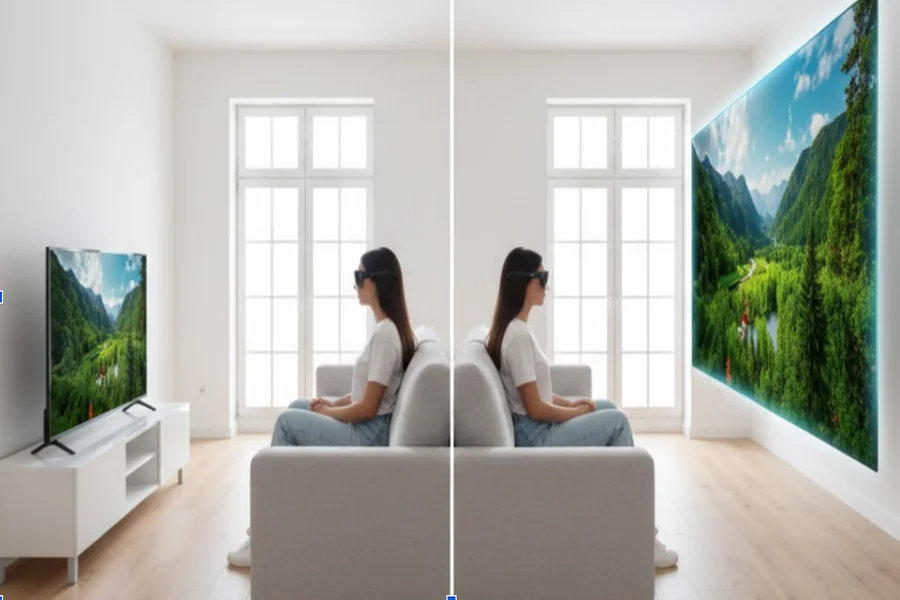
My living room is eleven feet wide. The 65-inch 4K TV I had in my cart was nearly five feet across. The math kept getting worse the longer I looked at it.
So I tried something smaller. A pair of AR glasses called the RayNeo Air 4 Pro. Thirty days in, the TV order is still canceled.
A 65-inch TV still wins for shared movie nights, sports parties, and group gaming. This article is not about those. It covers five scenarios where wearing a screen makes more sense than mounting one.
The Setup at a Glance
Here is the head-to-head. RayNeo’s figures come from the current product page; the 201-inch number is listed there as a perceived virtual display, not a physical panel. The TV column reflects mid-range 65-inch 4K models from brands like TCL and Hisense as a baseline.
| Spec | RayNeo Air 4 Pro | 65-Inch 4K TV (Mid-Range) |
| Display | 0.6″ Micro-OLED, 1,920×1,080 per eye | 4K LED/QLED panel |
| Screen | ~201″ perceived virtual | 65″ physical, ~57″ wide |
| Refresh | 120 Hz | 60–144 Hz, model dependent |
| HDR | HDR10 (source-dependent) | HDR10 / HDR10+ / Dolby Vision / HLG, varies |
| Audio | Bang & Olufsen tuned, open-ear | Built-in speakers vary |
| Weight | 76 g | ~37–55 lb (model dependent) |
| Power | Host-powered over USB-C | 100–200 W typical |
| Price | $299 | ~$450–$700 |
Scenario 1 — The Studio Apartment Problem
Mid-range 65-inch TVs measure roughly 57 inches across the screen alone. THX guidelines suggest around 8.7 feet of viewing distance for a 65-inch 4K display. Many studio apartments and bedrooms cannot deliver both numbers without compromise.
Why It Feels Too Big
RTINGS pegs roughly 4 to 8.5 feet as the range where most viewers resolve 4K detail on a 65-inch panel. Sit at the close end in a small room and the screen dominates peripheral vision. Subtitles drift to the edges. The set, not the show, becomes the focal point.
What the AR Glasses Change
A pair of AR Glasses such as the RayNeo Air 4 Pro creates what RayNeo’s product page calls a 201-inch perceived virtual display at a specific viewing distance. It is not a physical screen. Total wall hardware: zero. Total weight on your nose: 76 grams.
The Renter’s Math
A 65-inch panel needs a stand or wall mount. Wall mounting in a rental often violates the lease. AR glasses skip both costs. For renters and dorm residents, that fact alone can decide the purchase before any spec comparison begins.
Scenario 2 — Red-Eye Flights and Hotel Rooms
A 65-inch TV does not fit in a carry-on. The seatback screen on most economy flights sits between 9 and 13 inches. Hotel TVs are unpredictable and rarely calibrated. Long-distance travelers have always needed a different answer.
USB-C, Not Wi-Fi
The RayNeo Air 4 pro plugs directly into a phone, tablet, MacBook, or Steam Deck over USB-C. Basic display is plug-and-play with no Wi-Fi setup and no companion app. Advanced features may depend on the host device, cable, and source content.
76 Grams in a Travel Bag
The AR glasses weigh 76 grams and fold flat into the included case. They displace less space than a pair of over-ear headphones. A 65-inch TV stays home, by definition. The portability gap between the two products is total, not incremental.
Local Files Over Streaming
Download a movie to your phone before boarding. The glasses display whatever content the host device is allowed to output. No airline Wi-Fi paywall to negotiate. USB-C iPhone models listed on RayNeo’s compatibility page can output supported content directly, with app behavior dictated by the source.
HDR and 3D, in Coach Class
The display is a 0.6-inch Micro-OLED panel rated at 200,000:1 contrast with HDR10 support for compatible sources. RayNeo lists AI SDR-to-HDR upscaling and 2D-to-3D conversion for supported content. Per RayNeo’s footnote, real results depend on source quality and device support.
Scenario 3 — Late Night, Without Waking the House
Television speakers fire into the room. Even at low volume, an action scene rumbles through the floor. Bluetooth headphones lag the picture by enough to break dialogue sync. The result is the late-night standoff, and nobody wins it.
The RayNeo Air 4 Pro uses four open-ear speakers tuned in partnership with Bang & Olufsen. RayNeo lists a Whisper Mode designed to significantly reduce outward sound leakage through phase-canceling acoustics. A passive SoundTube accessory tightens the seal further. Real-world audibility still depends on volume and ambient noise.
Scenario 4 — Handheld Gaming Goes Big
Handheld gaming hardware has gotten powerful. Display real estate has not. A Steam Deck OLED measures 7.4 inches diagonally. A Nintendo Switch 2 ships with a 7.9-inch display. The visual gap between handheld play and a docked living-room setup is the obvious daily limit.
Plug In, Keep Playing
Connect a Steam Deck to the RayNeo Air 4 Pro over USB-C and the same game now fills the equivalent of a 201-inch perceived screen. No external monitor. No HDMI dongle. No dock. The AR glasses run at 120 Hz, which matters for shooters and racing titles.
HDR on a Handheld
HDR support varies by handheld, game, and output path. RayNeo lists iPhone, Mac, PC, and Switch 2 among the devices supported for HDR10 through the glasses. The Vision 4000 chip also runs AI SDR-to-HDR upscaling on the display side for compatible content.
Battery Math for the Road
The AR glasses draw their power from the host device. Steam Deck OLED battery life is rated 3 to 12 hours and depends heavily on the game. For lighter titles on shorter flights, the setup holds up. Heavier games will drain a handheld faster.
Scenario 5 — A Second Screen You Can Pack
Working from a hotel room with one laptop slows everything down. A second monitor lives at the office and stays there. Plug the RayNeo Air 4 Pro into a MacBook over USB-C and the AR glasses appear as an extended display in System Settings.
A Private Screen in Public Seats
On an airplane, a coworking desk, or an open-plan office, screen privacy matters. The glasses can keep the main viewing area private, especially when the laptop’s own screen is dimmed or closed. For drafting client documents in transit, that changes what work is possible.
Vision-Comfort Specs Worth Reading
The RayNeo Air 4 Pro runs 3,840 Hz PWM flicker-free dimming and carries TÜV SÜD Low Blue Light certification. For multi-hour working sessions, these specs are not marketing decoration. They are the difference between three productive hours and a headache that lasts through dinner.
The Bottom Line
Five different situations point at one answer. A head-worn 0.6-inch Micro-OLED display that scales to a 201-inch perceived virtual picture, runs on USB-C, weighs 76 grams, and slides into a coat pocket. At $299, the RayNeo Air 4 Pro is one of the strongest value plays in the AR glasses category today. For travel, small spaces, handheld gaming, and private second-screen work, it solves problems other display formats cannot match in the same package.