Every day, people and heavy machines work side by side in mines around the world. Loaders, trucks, drill rigs and utility vehicles move through tunnels and across pits, often in conditions where visibility is limited. Proximity detection technology helps reduce the risk of collisions by warning operators and pedestrians when they are too close to one another. Understanding how this technology works helps explain why it has become such an important part of modern mine safety.
What proximity detection does
Proximity detection systems monitor the space around a machine and detect when a person, vehicle or object enters a defined zone. When this happens, the system alerts the operator, the pedestrian or both. More advanced systems can be linked to the machine’s controls, slowing or stopping it automatically if a collision appears likely. The goal is simple: to give people the information they need, at the right moment, to avoid an accident.
Detection zones
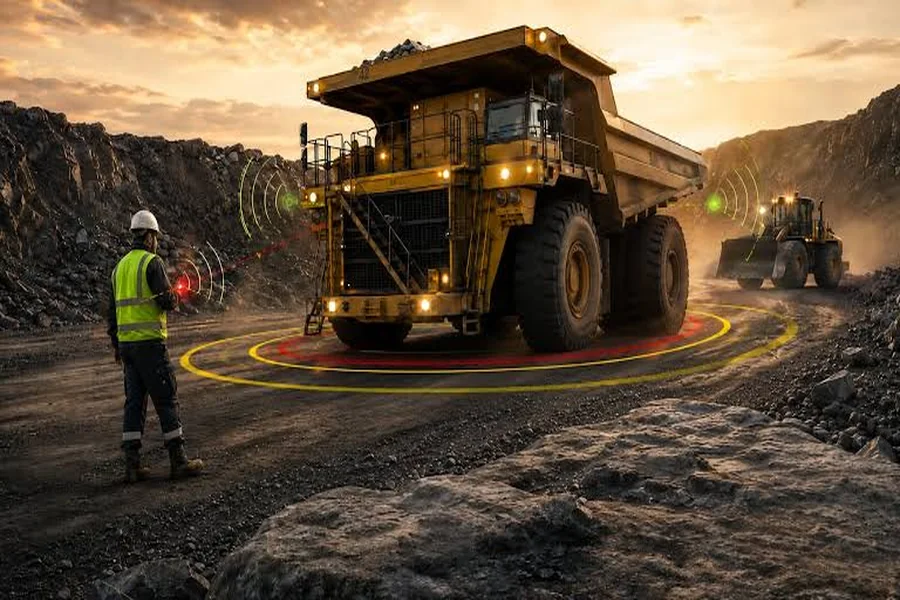
At the heart of every proximity detection system are detection zones, invisible areas around a machine that trigger alerts when another person or vehicle enters them. Most systems use several zones. An outer zone might provide an early warning, while an inner zone triggers a more urgent alarm or an automatic response.
Zones can be configured to suit different machines and situations. A large loader may need bigger zones than a light vehicle, and zones may be extended in the direction of travel or adjusted based on speed. Careful configuration helps ensure alerts are timely and relevant, reducing unnecessary alarms.
Tag-based systems
Many proximity detection systems use tags, small electronic devices worn by people or fitted to vehicles. Machines are equipped with readers or antennas that detect these tags and calculate how close they are. Tags are often built into cap lamps or worn on clothing, so they become part of a worker’s standard equipment.
Different radio technologies are used for tag-based systems. Some rely on low-frequency magnetic fields, which can provide reliable detection around large machines in underground conditions. Others use ultra-wideband radio, which can measure distance with high accuracy. Radio frequency identification is also used in some systems. Each technology has strengths depending on the environment and the level of precision required.
Sensor-based detection
Not every object in a mine carries a tag. Sensor-based technologies detect people, vehicles and obstacles without relying on tags. Radar can detect objects in dusty or dark conditions where cameras may struggle. Lidar uses laser pulses to create a detailed picture of the surroundings. Camera systems give operators a view of blind spots, and some use image analysis to identify people automatically.
On surface mines, GPS-based systems allow vehicles to share their positions with one another, providing awareness of other machines across a wide area. Many modern systems combine several of these technologies to provide more complete and reliable coverage.
Alerts and responses
When a proximity detection system identifies a potential hazard, it alerts the people involved. In the cab, operators may receive visual warnings on a display, audible alarms or both. Pedestrians wearing tags may receive vibrations, lights or sounds from their device, warning them that a machine is nearby.
In intervention systems, the proximity detection technology is connected to the machine’s controls. If a person enters a critical zone and the operator does not respond, the system can automatically slow or stop the machine. This provides an important final layer of protection.
Integration with machines
For proximity detection to work effectively, it must be properly integrated with the machines it protects. Sensors and antennas need to be positioned to give good coverage around the machine, including blind spots. For intervention systems, there must be a reliable interface between the proximity detection system and the machine’s braking or control systems.
Equipment manufacturers increasingly design machines with this integration in mind, simplifying installation and improving reliability. Choosing technology developed specifically for collision avoidance in mines helps ensure systems are robust enough for harsh mining environments, including dust, moisture, vibration and extreme temperatures.
Managing false alarms
One of the biggest challenges with proximity detection is balancing sensitivity with practicality. A system that is too sensitive can generate frequent alarms in normal working situations, such as when people work close to machines during maintenance. Too many unnecessary alerts can lead to alarm fatigue, where operators begin to ignore warnings. Careful zone configuration, intelligent filtering and features that recognise specific situations, such as authorised maintenance work, help keep alarms meaningful.
Data and continuous improvement
Proximity detection systems record data on every interaction they detect. This information can be analysed to identify patterns, such as locations where near misses occur frequently or times of day when interactions are most common. Mine managers can use these insights to improve traffic management, redesign high-risk areas and target training where it is most needed.
Training and culture
Technology works best when people understand it. Operators need to know what each alert means and how to respond, while pedestrians need to understand how to wear and maintain their tags. Training should emphasise that proximity detection is an additional safeguard, not a replacement for safe behaviour, clear communication and good traffic management.
An essential layer of protection
Proximity detection technology gives operators and pedestrians greater awareness of the hazards around them, helping prevent collisions in some of the most challenging working environments. By combining tags, sensors, intelligent alerts and integration with machine controls, these systems provide a vital layer of protection. As technology continues to advance, proximity detection will remain at the forefront of efforts to make mining safer for everyone.