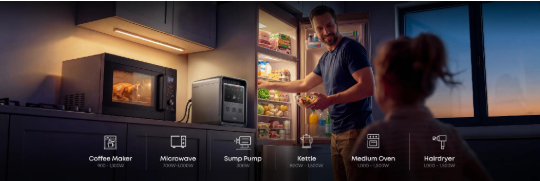
A power station is sold by watt-hours and bought for appliances, and the two are not the same language. The label states watts, the box states watt-hours, and the two only meet in a multiplication. The number on the box says nothing until it is divided by what a device draws and how long it runs. Motors, heaters and electronics make very different demands on the same rated output, which is where most surprises come from. The surge figure is printed too, usually beside the running watts and often three times larger on the same label. The aim here is to turn a device list into a runtime estimate and a sensible load order.
Device Categories
Small Electronics and Lighting
Phones, routers, laptops, lamps and a television are the loads that make an outage feel like an inconvenience rather than an emergency. A router and modem together draw under 20W, a laptop about 50W while charging, an LED lamp less than 10W. Add them up and the total is smaller than most people expect, which is why a 1kWh unit runs a whole evening of them with capacity to spare. A television adds 60 to 120W, which is a rounding error beside a heater. Count what you actually own rather than what the packaging suggests, and the list gets shorter. A television adds 60 to 120W, and a games console about 150W while it loads. If the goal is to keep internet on during blackout, this is the easiest version of the problem. A laptop charges faster asleep than awake, which halves its share of the budget.
Appliances With Motors
Motors are the ones that surprise people. A fridge compressor, a well pump, a circular saw and a microwave all pull a startup surge several times their running load, and the surge lasts only a second or two. A unit rated at 1,500W continuous with 3,000W peak will start most household fridges and a small pump, but not both at the same moment. Read the surge figure on the appliance label rather than the running watts, and start the heaviest device first. A fridge that averages 60W pulls several hundred for a second at each start, which is what trips a small unit. Start the heaviest device first with everything else off, and add the rest once it is running. The Anker SOLIX S2000 is built for exactly this: 1,500W rated with 3,000W peak to start a compressor, and 2,010Wh to keep it running.

Output Ratings
Continuous vs Peak Output
Two numbers describe the output, and they answer different questions. Continuous rating is what the unit delivers all evening; peak is what it can deliver for a few seconds while a motor spins up. A unit with a high peak and a low continuous rating is a burst performer, which suits tools and struggles with a heater. Ask for both numbers before buying, because one without the other tells you nothing useful. A welder and a space heater can share a rating and behave nothing alike. One number describes the whole evening, and the other describes the first second of it.
Outlet Types and Port Limits
The sockets decide what is possible before the battery does. AC outlets, USB-C with power delivery, a 12V car socket and a 30A RV port are not interchangeable, and a 100W USB-C port will not run a fridge no matter how large the battery behind it. Add up the port ratings against the devices you actually own, because the limiting factor is often one port rather than the whole unit. The port is a doorway, and a wide battery behind a narrow door is still a narrow door. Count the ports you need at once rather than across an evening. Two outlets sharing one circuit are one outlet when both are loaded.
Runtime Estimation
Watt-Hour Math
The estimate is one division. Multiply each device’s watts by the hours you want from it, add the results, divide by the unit’s watt-hours, then take off about fifteen per cent for conversion losses. A fridge averaging 60W across a day is 1,440Wh; a router at 15W is 360Wh. A plug meter read across a full day removes the guesswork and costs less than the food in the fridge. Round down rather than up, because the last ten per cent is where plans break. Write the total on the unit and the argument ends before it starts.
Load Shedding Priorities
Decide in advance what goes first when the budget runs short. Lights and communications usually cost so little that they never need cutting; heating, cooling and cooking are the three that eat a battery alive. Rotate the heavy loads rather than running them together, and put them on during daylight if you have panels producing. Anything that makes heat is expensive and anything that makes light is nearly free, so ninety seconds in a microwave is cheaper than four minutes in a kettle. Put the fridge on first and the kettle last, and the evening runs itself. A kettle is the most expensive thing in most kitchens, measured in watts. Rotating loads is cheaper than buying capacity.
Conclusion
Any device fits if the startup draw, the ports and the hours all line up. Check the surge rating before the running watts, keep the small loads cheap, and do the division once in daylight so you are not doing it by torchlight. The label is not the answer; the division is, and a managed unit lasts roughly twice as long as a merely large one. A label is a claim, the division is a fact, and only one of them survives contact with an evening of real use. Write the total on the case and the next evening starts from a known number.