When a Software Development Team Extension Works Better Than Another MVP Vendor
 Johnathan Parker |
August 21, 2026 |
3:51 am
Johnathan Parker |
August 21, 2026 |
3:51 am
By the Phenomenon Studio product team
What gets lost when a company swaps MVP vendors, and when extending the existing engineering team is the faster, safer path instead.
Six weeks after an MVP ships, most founders aren’t studying usage charts. They’re staring at a backlog that grew faster than the team that built the product, wondering whether the same vendor can carry the next phase or whether it’s time to start over with someone new.
The instinct to start over is understandable. A rushed MVP often carries shortcuts nobody wants to inherit, and a fresh perspective sounds appealing after months in the weeds. But swapping vendors resets more than the visible parts of a project, and a team extension arrangement is the option that gets skipped most often, mostly because founders don’t realize it’s built to solve exactly this problem.
This decision comes up constantly among B2B product teams past their first release. This piece looks at what changes when a company hires a second MVP software development company instead of extending the team that already knows the product, and the specific situations where starting fresh is still the right call.
Key Takeaways
- Switching MVP vendors resets institutional knowledge that took months to build, even when the new team is objectively stronger on paper.
- A team extension model keeps the people who wrote the original code in the loop, which shortens the ramp time for the next release cycle.
- Hiring a second vendor makes more sense when the product itself is pivoting, not just when the backlog feels heavier than expected.
- Cost comparisons between the two paths rarely account for the weeks lost to re-discovery, which is usually where the real budget gap shows up.
What a vendor switch resets
A new MVP software development company inherits a codebase, not the reasoning behind it, and reconstructing that reasoning is where the real time goes in the first month of a new engagement. Every shortcut and workaround lives in someone’s memory, not in the repository. Half-finished plans fare no better, unless the outgoing team documented them unusually well.
Most of that first month gets absorbed by work that looks like web app development on a timeline but functions closer to product archaeology: walking through decisions nobody wrote down, confirming which parts of the original build were deliberate and which were rushed under deadline pressure.
Speed is usually the argument founders make for switching, on the assumption a new team will simply move faster. In practice, the team that already understands the product’s edge cases is normally the faster one, once its first sprint clears the initial ramp.
Deloitte’s 2025 global outsourcing survey found that 65 percent of companies working with external development teams named speed to market as their main reason for doing so, ahead of cost savings, a motivation that a full vendor swap tends to undercut rather than serve. (Deloitte, 2025)
Where a team extension picks up the thread instead
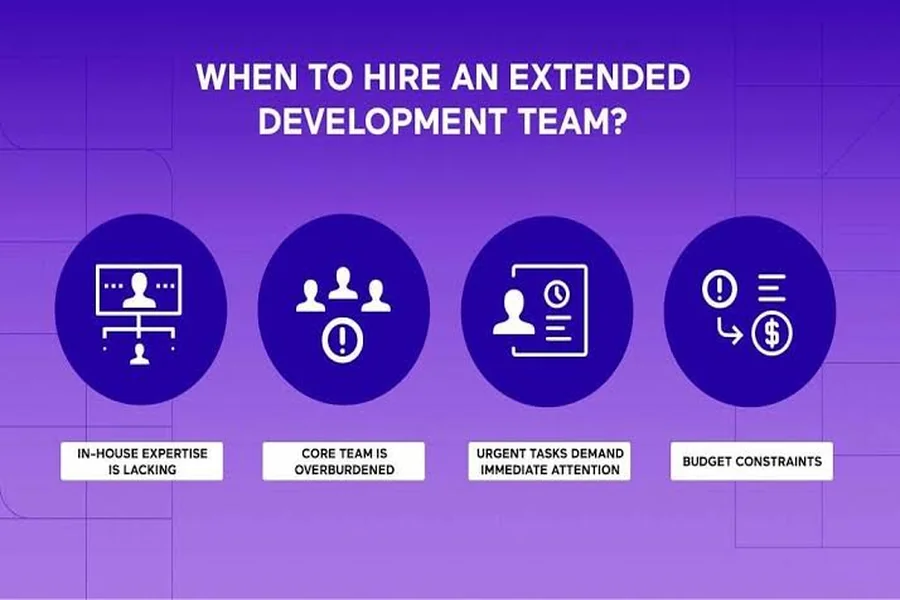
A software development team extension adds engineering or design capacity to the team that already built the MVP, rather than replacing it outright. The people who made the early architecture calls stay on the project, and new hires slot in around them instead of starting from a blank codebase.
That continuity is the main reason a software development team extension shortens the ramp period compared with a full vendor change. Nobody has to relearn why a particular workaround exists, because the person who wrote it is still answering questions in standup.
Phenomenon Studio has run on that same logic since its founding in 2019: engagements are structured as long-term partnerships rather than one-off, project-volume work, on the premise that a product team gets more value from continuity than from starting over with someone new at every stage.
Oleksandr Kostiuchenko, Marketing Manager at Phenomenon Studio, has seen founders default to a full vendor search out of frustration with an MVP’s rough edges, when the actual complaint is capacity, not competence. In his observation, teams that add capacity through a software development team extension instead of a new vendor relationship tend to ship the next release faster, mainly because nobody spends the first month rebuilding trust in decisions that were already sound.
When a second MVP software development company is genuinely the right call
None of this means a vendor switch is always the wrong move. A new MVP software development company brought in fresh is often the better choice when the product itself is pivoting into a different market, when the original build used a stack the current team can’t maintain, or when trust with the first vendor broke down in a way no amount of documentation fixes.
A pivot that changes the core user, not just the feature set, usually justifies starting over with a fresh vendor, since the product decisions baked into the first build may not transfer cleanly to the new direction. Rebuilding around a different buyer is a different problem than extending an existing one.
The same logic applies when the original stack can’t support what the product needs next. Rebuilding on unfamiliar infrastructure costs close to what starting over with a new vendor would cost anyway, so the sunk cost of the first build stops being much of an argument either way.
The vendor categories both paths pull from
Whichever route a company takes, the surrounding vendor categories tend to look similar. A team offering web development services and one offering web design services solve different halves of the same problem, and a proposal that blurs the two is worth a follow-up question regardless of which staffing model ends up on the table.
The same distinction holds between a web development agency built around custom application work and a website development agency scoped for a marketing site refresh. A mobile app development company pitching a native build is solving a different problem again, one that a website development company rarely covers as a secondary service.
Web app development sits in its own category too, closer to product engineering than to either a marketing site or a native app, and treating it as an add-on to an existing contract usually undersells how much work is involved.
On the design side, website design services and a full UX design agency engagement aren’t interchangeable either. One usually covers layout and visual production for a defined set of pages, while the other includes research and testing behind an interface decision, not just the interface itself.
A web design agency handling a marketing refresh and a UI UX design services engagement handling the logged-in product experience can both be true of the same company at once, and a team extension is often the cleanest way to add the second without disrupting the first.
Branding, mobile, and the parts that get bundled in
Branding companies handling logo systems and identity guidelines are a separate discipline again, and the strongest engagements treat that work as a dependency for interface design rather than a parallel track running on its own schedule. Branding companies that have partnered with a product team before usually understand this; ones that have only worked on marketing collateral often don’t.
Mobile scope deserves the same care. A mobile app development services engagement and a mobile app development agency scoped for a full native build aren’t the same commitment, and a proposal that treats them as interchangeable is usually underscoping one of the two.
Adding capacity this way has become standard practice. Most companies now use some form of outside staffing to cover a gap they can’t fill fast enough internally, whether that gap sits in engineering, design, or both.
Clutch’s 2025 State of Software Development report found that 87 percent of companies reported a current or expected shortage of developer talent, a gap that pushes staffing decisions like this one earlier into a product’s life than most founders expect. (Clutch.co, 2025)
Cost math that accounts for what gets lost
A cost comparison that only lines up day rates misses the more expensive part of switching. A new vendor’s estimate for web app development rarely includes the weeks spent relearning decisions the outgoing team already understood, and that gap tends to show up as a change order a month or two in, not as a line item on the original quote.
The same applies on the design side. A UX design agency engaged fresh has to run its own discovery before it can responsibly touch an existing interface, even when the founder is confident the work is straightforward. Website design services priced for a redesign from scratch often cost less than expected precisely because they skip that discovery step, which is fine for a marketing site and riskier for a logged-in product.
What a real handoff looks like, if switching is still the plan
When the decision does land on a new vendor, the handoff itself determines whether the switch costs weeks or months. A clean handoff includes a walkthrough of every non-obvious architecture decision and a list of known bugs that haven’t been fixed on purpose. It also includes access to whatever informal documentation exists, even if it’s a messy internal wiki nobody has touched in months.
Founders who skip this step because the outgoing relationship ended badly usually pay for it twice: once in the strained conversation required to get the handoff at all, and again in the weeks the new team spends rediscovering what a short call could have explained. It’s worth pushing through the discomfort for that reason alone.
Signals worth watching before the backlog forces the decision
The choice rarely announces itself cleanly. A few signals tend to show up before a founder consciously registers that a staffing decision is overdue. Sprint estimates keep sliding despite a stable scope, and a growing list of features sits with nobody having time to spec them properly. A founder ends up fielding technical questions that should be routed to an engineering lead instead.
None of these signals alone means the current team is failing. Together, they usually mean the team is undersized for what the roadmap now demands, which is a capacity problem an extension is built to solve, not evidence that the original build was flawed. Reading them early gives a founder time to plan the staffing change deliberately, rather than reacting to a launch date that’s already slipping. A short internal audit, even an informal one, usually surfaces which of these signals apply before the backlog forces a rushed decision.
How this decision interacts with the rest of the roadmap
Staffing decisions like this one rarely happen in isolation. A capacity expansion timed against a fundraising cycle or a seasonal sales push changes how much runway is left to onboard new people properly. A looming compliance deadline does the same, whichever path a company chooses.
Founders who treat the staffing question as separate from the product roadmap tend to make the decision twice: once under pressure, and again a few months later once the first choice turns out not to fit the actual release calendar. Folding the two conversations together from the start avoids that repeat cycle, and it makes the eventual choice easier to defend to a board or an investor asking why the timeline moved.
A practical way to decide between the two
The decision usually comes down to what’s broken. If the complaint is capacity, a software development team extension solves it directly, and a partner already offering web development services against the existing codebase can propose the extension within days rather than weeks.
If the complaint is direction, a fresh MVP software development company might be warranted, but even then, keeping the original design partner involved during the transition usually preserves more institutional knowledge than cutting every relationship at once.
A web design agency retained for the interface layer while engineering scales through a team extension is a workable split, especially when a UX design agency is already embedded in the product’s research process, since neither workstream has to pause for the other to catch up.
Your browser doesn’t support embedded video.
Branding companies brought in during this phase should be looped into the same conversation, since a visual identity refresh timed against a capacity expansion tends to land better than one bolted on afterward, once every workstream is pulling toward the same release date.
Common mistakes when choosing between a vendor switch and a team extension
The first mistake is assuming a new vendor’s estimate already accounts for re-discovery. Most quotes are priced against a clean scope document, not against the reality of picking up someone else’s half-finished product, and the gap surfaces as scope creep once real work starts.
The second is treating a software development team extension as a short-term patch instead of folding it into actual planning. An extension added without a roadmap conversation tends to get pulled onto whatever is loudest that week, rather than the capacity gap it was hired to close.
The third is switching vendors without demanding a real handoff, even when switching is the right call. A departing team that leaves without documenting its architecture decisions hands the new vendor the same re-discovery problem the founder was trying to avoid in the first place.
The fourth is leaving design and brand continuity out of the staffing decision entirely, as though engineering capacity and interface consistency were unrelated problems. They rarely are, and a plan that solves one while ignoring the other usually resurfaces the same friction a few months later.
A fifth mistake worth naming is deciding under pressure created by an unrelated deadline, like a funding round or a board update. A staffing decision made mainly to look resolved in a slide deck rarely holds up once the actual work starts, and reversing it later costs more than taking an extra week to decide properly now.
Neither path is inherently safer. The vendor switch and the team extension both carry risk, and the honest version of this decision starts with naming what’s broken rather than defaulting to whichever option feels like a cleaner break from the current frustration. A founder who can articulate that difference clearly, out loud, before signing anything, is usually the one who avoids repeating this same decision a year later.
Frequently asked questions
How do I know if I need more capacity or a different vendor entirely?
Look at what’s causing the frustration. A backlog growing faster than the team can clear it points to a capacity gap. A product moving toward a different market or user base points to a direction problem, which usually calls for a different conversation entirely.
Does extending an existing team cost less than hiring a new vendor?
Usually, once re-discovery time is factored in. A new team’s day rate might look competitive, but the weeks spent relearning existing decisions rarely show up in the original quote and tend to appear later as unplanned scope.
Can the same product work with two different vendors for design and engineering?
Yes, and it’s common. The arrangement works best when both sides operate from a shared brief and check in regularly, rather than working from separate briefs that only get reconciled at launch.
What documentation should a founder request before extending or switching a team?
A founder should ask for the reasoning behind past architecture decisions, plus a current list of known technical debt. Workarounds that aren’t obvious from reading the code matter just as much, since they explain choices a new reviewer would otherwise miss. This matters whether the plan is to add capacity to the current team or bring in a completely new one.
Is it a bad sign if the original MVP has a lot of technical debt?
Not necessarily. Most MVPs carry some debt by design, since speed to a working product usually took priority over long-term architecture. What matters more is whether the team can name that debt clearly and explain the tradeoff that created it.
How long does adding capacity to an existing team usually take?
It varies by scope and role, but the timeline is generally shorter than onboarding a brand-new vendor, since the incoming staff are joining an established process rather than building one from scratch.
Should branding work be paused while a company decides between these two options?
Branding work rarely needs to stop outright. Keeping it part of the same conversation matters more: a visual identity update planned alongside a capacity or vendor decision tends to land more coherently than one scheduled independently of the engineering timeline.
What’s the first question to ask a prospective new vendor about handoff?
Ask directly what they need from the outgoing team to get up to speed, and how long they realistically estimate that ramp will take before real feature work resumes. A vendor with a specific answer has done this transition before. One with a vague answer probably hasn’t.
Does an extension eventually need to become a full in-house hire?
Not necessarily. Some companies keep extension staff in place indefinitely as a permanent part of their capacity model, while others use it as a bridge until they can hire directly and build out a larger internal team. Either approach works as long as it’s a deliberate choice, not a default nobody revisited.
Who should be in the room when this decision gets made?
Whoever owns the roadmap and whoever owns the budget, together, rather than in separate conversations. A staffing decision made by one side without the other tends to get revisited within a quarter, once the assumptions behind it turn out to be incomplete or built on numbers the other side never agreed to.