Automotive Injection Molding: From Part Design to Stable Production
 Johnathan Parker |
September 18, 2026 |
10:30 pm
Johnathan Parker |
September 18, 2026 |
10:30 pm
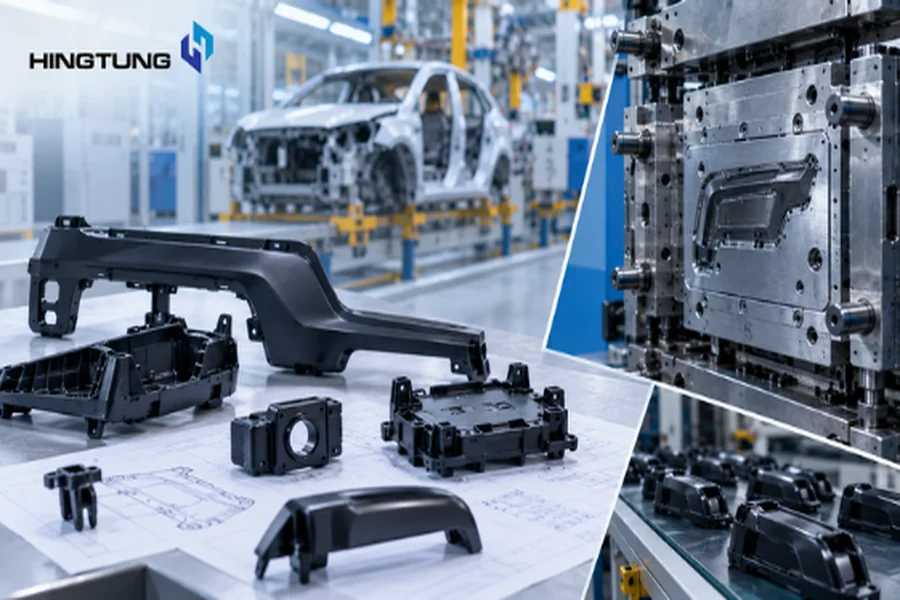
A good first sample does not guarantee a good production program. For automotive injection molding companies, the harder challenge is maintaining dimensions, appearance, assembly fit, and process stability after thousands of molding cycles.
HingTung has supported custom plastic manufacturing since 2011. In automotive projects, our engineering focus is therefore not simply getting the mold to produce a complete part. The real target is a repeatable process that can continue producing acceptable components under normal production conditions.
Stage 1: Freeze the Requirements That Affect Manufacturing
Before discussing mold construction, define what the component must survive and how it interacts with the rest of the product. A hidden mounting bracket and a visible interior component may require completely different engineering priorities.
For automotive plastic components, these requirements directly influence manufacturing decisions:
| Part Requirement | Manufacturing Impact |
| Elevated temperature | Resin and grade selection |
| Tight mating fit | Tolerance and inspection strategy |
| Cosmetic surface | Gate, ejector and texture decisions |
| High annual volume | Cavity count, mold steel and automation |
| Chemical exposure | Resin compatibility |
| Snap-fit assembly | Material strain and feature geometry |
This information should be available during DFM. Changing a gate position or rib before tooling is relatively simple. Discovering after T1 that a weld line crosses a critical feature is much more expensive.
Stage 2: Let the Resin Change the Design
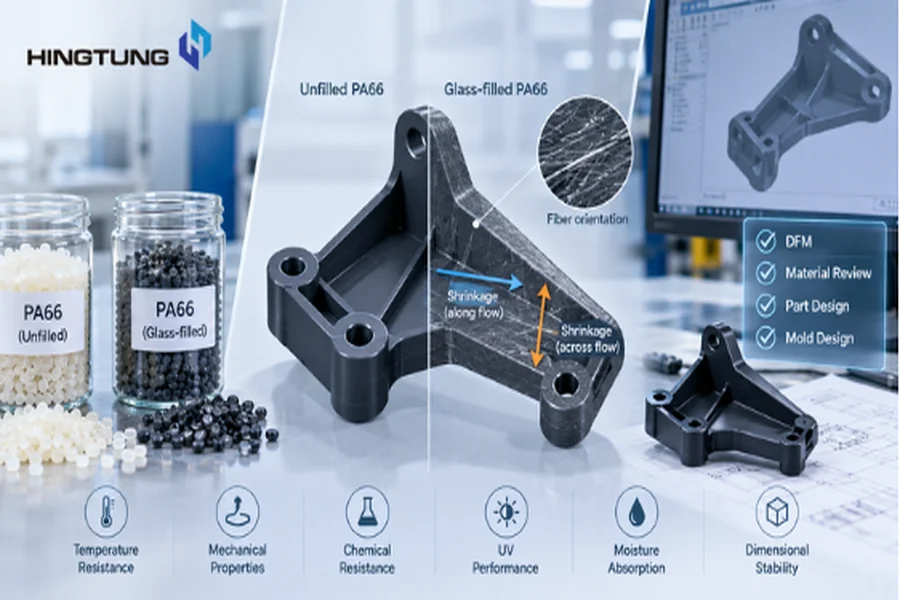
Material selection should not happen independently from part and mold design.
Consider a bracket initially designed in unfilled PA66. If the material changes to a glass-filled grade to increase stiffness, the CAD geometry may remain identical, but the molding behavior does not.
Glass fibers tend to orient with melt flow. This can create different shrinkage behavior along and across the flow direction, increasing the importance of gate location, wall geometry, and cooling balance. The same principle applies to other automotive plastic materials: changing resin can alter flow, shrinkage, moisture response, and dimensional behavior.
At HingTung, material review is therefore incorporated into DFM. For automotive injection molding, the question is not simply whether a resin meets the mechanical specification, but whether the part and tooling strategy make sense for that specific grade.
Stage 3: Build the Mold Around the Production Target
Annual volume changes mold engineering decisions.
Suppose an automotive plastic parts manufacturer receives a program requiring 600,000 parts per year. Assume:
1.300 production days;
2. 20 available hours per day;
3. 30-second molding cycle;
4. single-cavity mold.
The theoretical output is:
3,600 ÷ 30 × 20 × 300 = 720,000 parts/year
At first glance, one cavity appears sufficient.
But production does not operate at 100% utilization. If effective production time is 80% after maintenance, setup, interruptions, and other downtime:
720,000 × 80% = 576,000 parts/year
The theoretical single-cavity solution now falls below annual demand.
This is why cavity count cannot be selected from part geometry alone. Demand, cycle time, machine availability, maintenance, scrap allowance, and required capacity buffer all belong in the tooling discussion.
Stage 4: T1 Is Where the Real Engineering Starts
The first mold trial should generate evidence, not just samples.
A filled cavity confirms that molten resin can reach the required geometry. It does not confirm dimensional stability, cooling balance, ejection performance, or a suitable production window.
When a T1 problem appears, its visible symptom does not automatically identify its root cause.
| T1 Finding | Possible Factors to Investigate |
| Short shot | Flow restriction, venting, temperature, speed |
| Flash | Pressure, clamp force, parting-line condition |
| Warpage | Cooling, packing, geometry, fiber orientation |
| Sink | Local thickness, packing, cooling |
| Weld line | Gate position, flow fronts, temperature |
| Dimensional deviation | Shrinkage, process, cooling, steel condition |
For example, if a critical dimension is oversized, immediately removing steel can make the situation worse. The engineering team should first determine whether the result is driven by cavity geometry, actual resin shrinkage, packing conditions, mold temperature, or cooling imbalance.
HingTung keeps mold making, mold trials, and production molding within the same workflow so tooling and process engineers can review the same trial data before deciding whether steel modification is necessary.
Stage 5: Find the Process Window, Not the Perfect Setting
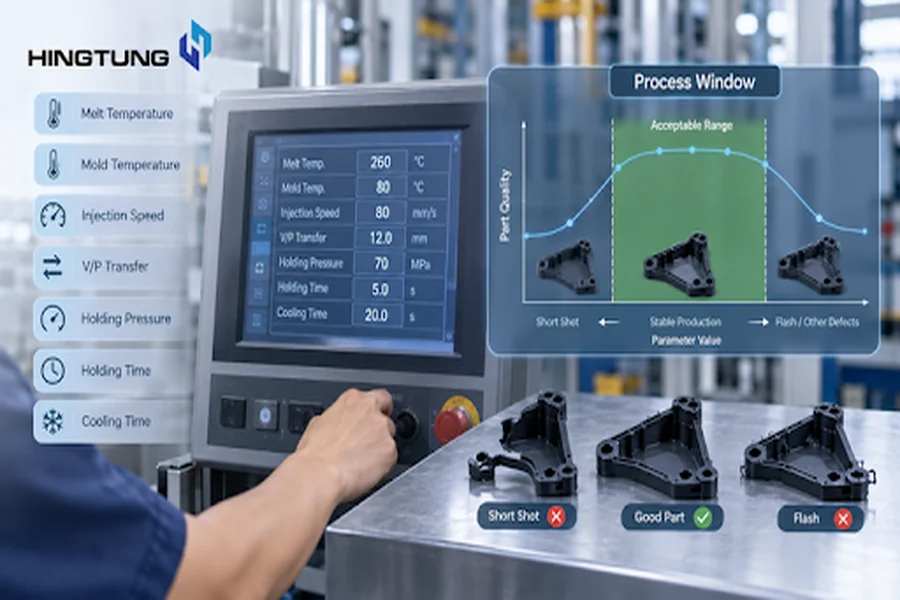
There is an important difference between finding one machine setting that produces a good part and establishing a stable molding process.
A production process normally involves interacting variables such as melt temperature, mold temperature, injection speed, V/P transfer, holding pressure, holding time, and cooling time.
A robust process should tolerate reasonable operating variation while continuing to produce acceptable injection molded automotive parts.
If a small parameter change immediately creates flash, short shots, or dimensional failure, the process window may be too narrow for comfortable repeat production.
This is where trial data becomes more valuable than one set of attractive samples. Engineers should understand which variables significantly affect critical characteristics and establish appropriate operating limits before production release.
What 10,000 Parts Can Reveal That 20 Samples Cannot
Twenty good samples can hide problems that only become visible during continuous production.
As the mold reaches thermal equilibrium and the number of cycles increases, an automotive injection molding supplier may begin to see:
1. cavity-to-cavity dimensional drift;
2. gradual flash development;
3. unstable ejection;
4. changes in mold temperature;
5. actual scrap patterns;
6. color variation;
7. material-lot effects;
8. wear on moving components.
Multi-cavity molds add another layer of complexity. Suppose four cavities produce a critical dimension of:
C1: 32.04 mm
C2: 32.02 mm
C3: 32.11 mm
C4: 32.03 mm
If all parts are mixed before measurement, cavity 3’s behavior may be harder to identify. Maintaining cavity identification during validation makes troubleshooting much more useful.
The lesson is simple: approving selected parts and approving a manufacturing process are two different decisions.
Where HingTung Fits Into the Workflow
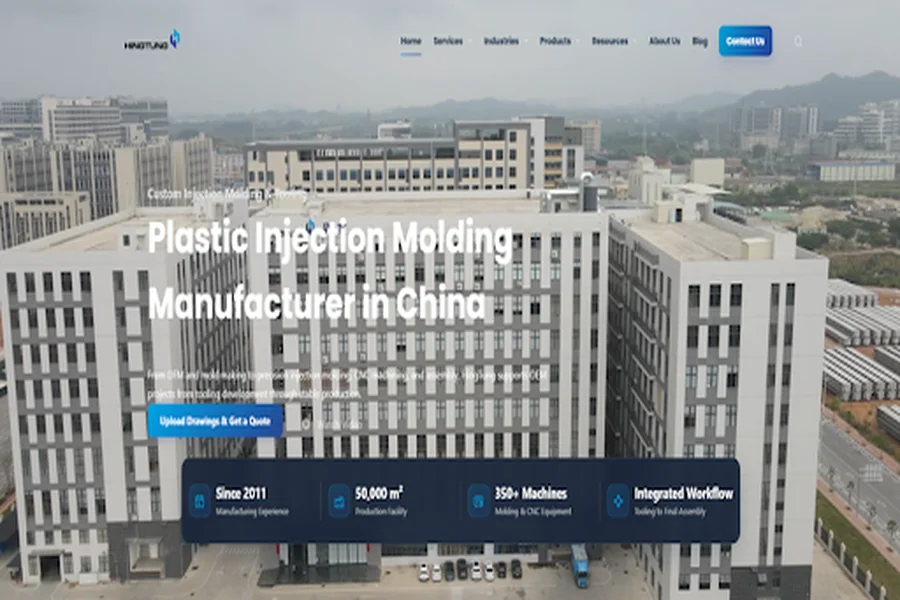
HingTung Injection Molding Manufacturer supports this progression within a 50,000 m² manufacturing facility, with 350+ pieces of equipment and more than 80 injection molding machines up to 650 tons.
Instead of separating tooling from downstream manufacturing, the workflow can remain connected:
DFM → Mold Making → Mold Trial → Injection Molding → Secondary Processing → Assembly → QA
This becomes useful when a production problem crosses process boundaries. If a housing does not assemble correctly, for example, the team can review the drawing, mold dimensions, molding conditions, dimensional inspection, and assembly result rather than assuming the problem belongs to one department.
HingTung also supports CNC machining, LSR/HTV silicone processing, sheet-metal work, secondary operations, and assembly for projects requiring more than molded plastic components alone.
For OEM programs, the practical advantage is not simply having more processes available. It is having a shorter engineering feedback loop when the part, mold, process, and downstream operation affect one another.
Three Questions Before Production Release
Before an automotive molded component moves into repeat production, I would want clear answers to three questions.
1. Is the Process Stable Without Constant Adjustment?
Experienced technicians can sometimes keep a marginal process running by repeatedly changing parameters. That is different from a process capable of operating consistently within an approved window.
Production approval should reflect normal operating conditions, not continuous manual correction.
2. Do Critical Dimensions Stay Stable After Thermal Equilibrium?
Parts produced immediately after startup may not represent the process after the mold reaches a stable operating temperature.
Critical dimensions should therefore be checked under representative production conditions, particularly where cooling balance, shrinkage, or fiber orientation can influence the result.
3. Can Important Changes Be Traced?
Resin revisions, mold corrections, drawing updates, process changes, and inspection revisions should not become informal shop-floor knowledge.
The required level of traceability varies by customer and component, but controlled changes make it much easier to investigate why production today differs from an earlier approved condition.
FAQs
Why can an automotive plastic part change dimensions after molding?
Cooling and shrinkage can continue after ejection. Hygroscopic materials such as nylon can also change dimensions as they absorb moisture. This is why measurement timing and conditioning requirements should be defined for dimensions sensitive to these effects.
Should visible and hidden automotive parts use the same inspection criteria?
Not necessarily. A hidden structural feature may be controlled primarily by dimensions and function, while a visible surface may also require agreed standards for texture, gloss, flow marks, weld lines, sink, and color. Inspection criteria should follow the function of each surface.
Can an automotive part change resin without modifying the mold?
Sometimes, but it should never be assumed. A different resin or grade can change shrinkage, flow behavior, packing response, warpage, and processing temperature. The engineering team should evaluate the new material against the existing mold and critical dimensions before production approval.
Conclusion: Approve the Process, Not Just the Part
For automotive injection molding companies, producing the first acceptable samples is only one milestone. The more meaningful objective is establishing a mold and process that continue producing conforming parts as the tool heats up, cycles accumulate, material lots change, and normal production variation appears.
HingTung supports this progression from DFM and mold making through molding, inspection, secondary manufacturing, and assembly. For an automotive OEM project, that connected workflow helps shift the focus from simply making a good sample to building a repeatable manufacturing process.