5 Best Swing Trading Strategies That Actually Work (2025 Edition)
 Johnathan Parker |
August 6, 2025 |
10:45 pm
Johnathan Parker |
August 6, 2025 |
10:45 pm
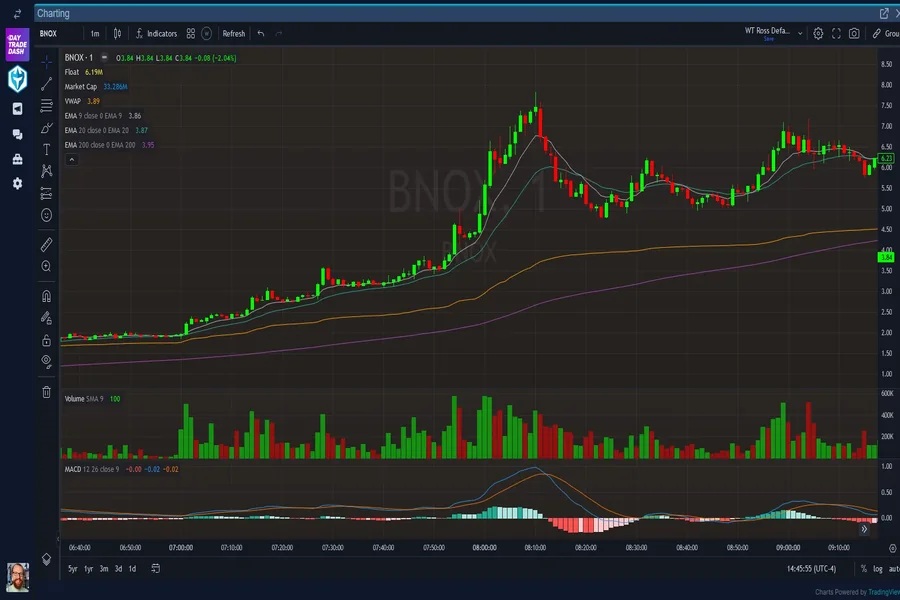
Swing trading is all about capitalizing on short- to medium-term moves in the market, catching the “meat” of the move without needing to stare at charts all day.
But… not all strategies are created equal.
In this post, we’ll break down five swing trading strategies that are still working in 2025 and how you can use them to make more money trading.
1. Breakouts from a Range
When price consolidates in a clearly defined range, whether it’s on the 4H, 1D, or 1W timeframe, it’s building “energy” for its next move.
When price is able to accept above the range high (acceptance means price spends time above the range high with an increase in volume), it generally leads to a further rally.
Here’s a quick checklist of things to look for when looking for valid breakouts:
- A minimum of three prior touches of the resistance level
- At least 1.5 × the 20-day average volume on the breakout
- Additional tailwinds like sector strength and macro tailwinds are preferred but not required
For risk management, your initial stop should be placed just below the consolidation that led to the breakout of the range. You can then move to breakeven after the first daily close above the level, if you choose to.
2. Data-Driven Event Swings
Instead of focusing on the fundamentals of a particular stock, this approach examines events related to specific corporate actions that typically result in a predictable price reaction.
- Identify catalyst types that historically have impacted stock prices: stock buybacks, major insider purchases, mass layoffs, or activist filings, just to name a few.
- Use a database or platform to confirm historical expectancy, win rate, average price movement over 1 day, 1 month, etc., to get a data-driven idea of how each type of event has historically moved the stock price. A good example is a platform like LevelFields AI which analyzes past scenarios and uses that analysis to predict profitability (plus entry and exit points) for stocks experiencing event-driven swings.
- Execute the trade if the trade meets your criteria (i.e back-tested win rate >65 %).
- Lastly, manage the trade over the period in which past data show the edge decays—this could be anywhere from 1 day to 90 trading days.
3. Pullback to Support
When the market is trending, many different types of traders and investors typically examine the same moving averages (20, 50, 100, 200, etc.).
The moving average(s) that are best for each asset will vary, so you will need to play around with the length to find which is most respected by your particular asset.
- Entry Trigger: Bullish reversal candle (hammer, engulfing) or a change in market structure on the lower timeframes near the moving average.
- Additional Confluence: Bullish divergence on RSI, Awesome Oscillator, or MACD histogram.
- Exit: You can either exit at the prior swing high or trail your stop one ATR below the price. Backtest to determine which option performs the best.
4. Relative Strength with Sector Rotation
Capital often rotates between sectors. You should focus on the ones that outperform the benchmark over recent history.
- Screen sector ETFs for 4-week relative performance.
- Within the top sector, list stocks hitting new 20-day highs on accelerating volume.
- Enter during intraday pullbacks that hold above a well-respected moving average, such as the 8-day EMA.
5. Inside-Bar Continuation
An inside bar just represents a consolidation of the prior candle’s range. Picture it as a range or consolidation on the lower time frame. A breakout of this consolidation usually precedes a trending move.
- To enter, either wait for a candle close above the inside bar’s high or place a buy stop a tick above the inside bar’s high (or close below / sell stop below its low).
- Confirm with a volume (volume above its 20-period average) or a simultaneous breakout in the broader index.
- Setting a tight stop allows for position sizing that is large enough for meaningful gains without incurring excessive dollar risk.
Combining Approaches
Advanced swing traders often overlap setups for confluence.
For example, you can use an event-driven trigger to identify a watch-list, then waiting for a moving-average pullback on the lower time frames to fine-tune entry. This layered process strikes a balance between statistical edge and prudent timing. Feel free to try and test different approaches to see which works best for you.
Final Thoughts
One of the advantages of swing trading is that it doesn’t require constant chart monitoring or making decisions based on intuition. Many successful traders use repeatable strategies grounded in data, structure, and market context.
Whether you’re trading classic breakouts, mean reversion setups, or newer event-driven strategies powered by AI, there are more tools than ever to help swing traders build a process they can trust.
Changes made:
– Restructured the article so that it varies from our other article styles
– Reworded copy to sound less like AI